




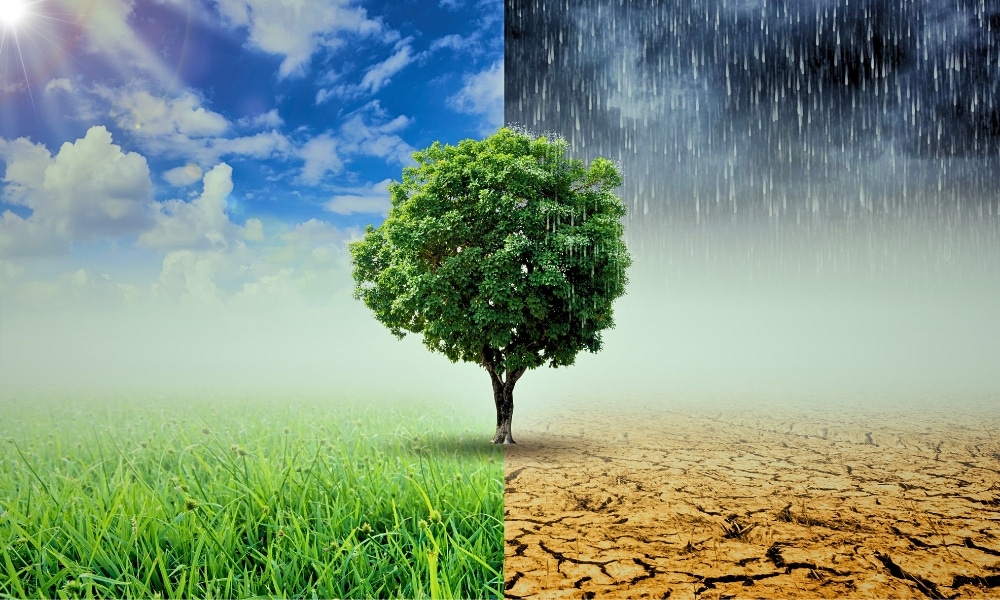

Kathmandu. About 4.5 billion people of the world live in areas that are at risk of major natural disasters. This is about 60 percent of the world’s population.
According to the World Bank’s Report on Poverty, Prosperity and the Earth, it is estimated that people living in such areas will experience catastrophic climate events at least once in their lifetime. The largest part of these extreme events are heat waves. They affect 42 percent of people worldwide. Then drought affects 18 percent, floods affect 10 percent, and cyclones affect 8 percent.



The report predicts that these figures are likely to increase further as climate change increases the frequency and intensity of these extreme events. The situation varies significantly between regions. South Asia has the highest number of populations (88 per cent) at risk of such disasters. It is followed by East Asia and the Pacific, where 68 per cent are affected.
The main reason for many of these events is heat waves. In South Asia, four out of every five people face extreme heat exposure. Whereas in East Asia and the Pacific, half of the population faces this risk. More than one in ten people in East Asia and the Pacific; the Middle East, North Africa, Afghanistan and Pakistan, and South Asia face the risk of flooding. Droughts are more prevalent in Europe and Central Asia, Latin America and the Caribbean, North Africa, and Sub-Saharan Africa. Beyond these aggregate figures, there are significant differences within the outlying regions.
The data available in regions such as Latin America and the Caribbean allow a detailed analysis of the impact of different climate risks within countries and even at the level of selected cities.
Looking at the income groups, this level of risk looks like an inverted-U curve. Lower-middle-income economies bear the most burden. In which 73 percent of the population is at risk. This is followed by upper-middle-income economies. Where this number is 55 percent. This rate is lower in low-income (41 percent) and high-income (32 percent) economies, although the types of risk vary.
Droughts are most prevalent in low-income economies. Heatwaves are most prevalent in middle-income economies. Still, these climate-related hazards do not discriminate between people, rich or poor, young or old, men or women.
On August 10, there was a devastating flood in the Bhotekoshi River flowing through the Nepal-China border. This flood has caused a huge loss of life and property.
According to the latest data of the National Planning Commission, the floods in Bhotekosh have caused such a huge loss to the households and business establishments. According to the survey results of the survey conducted by the commission, the maximum damage has been done to private houses. According to the press release issued after the survey, property worth Rs 69.57 billion has been destroyed on the household side alone.
Similarly, businesses and establishments have suffered a loss of Rs 9.60 billion. Apart from this, land, farms, food, livestock, vehicles and valuables have also been damaged.