



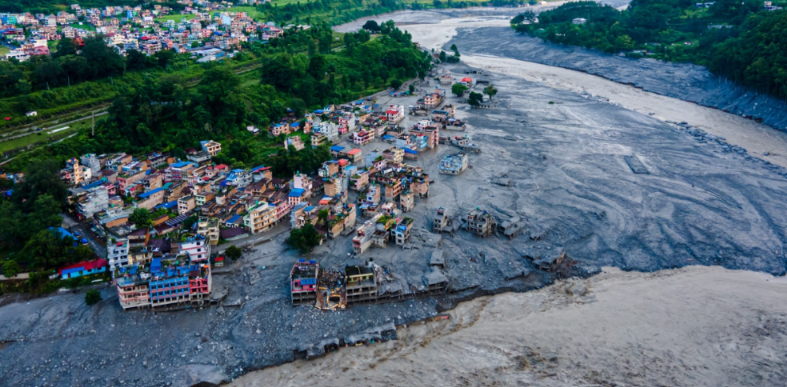

Kathmandu. The efforts being made by the international community for relief and reconstruction in the face of the irreparable human and material damage caused by the flooding of the Bhotekoshi River have brought to the fore a serious and worrisome reality, which is a big question mark on climate justice and international responsibility.
After Nepal’s continuous appeal at the international forum for reconstruction after the damage caused by the mudslides and floods in the Bhotekoshi River from Lhonde of Rasuwa on August 22, the board of the UN-backed Loss and Damage Fund called an emergency meeting for the first time and decided to allocate a total of Rs 21.6 million for Nepal. However, Nepal will have to complete a lot of paperwork to receive this amount. This support has become like a straw in the mouth of an elephant in the face of the need for funds needed for Nepal’s reconstruction and rehabilitation.



It is estimated that about $ 4.7 billion will be needed for post-flood reconstruction. Nepal has not yet received the announced $ 20 million. This assistance is less than 1 percent of the amount that Nepal has been committed to Nepal.
Thousands of people have been affected due to the severe floods in the Bhotekoshi river. More than 2,000 people have lost their lives. 5,000 people are still missing. Homes, roads, bridges have been destroyed and 430.7 MW of power generation and transmission capacity has been affected.
According to scientists and researchers, due to anthropogenic climate change, the local temperature has increased by about 1.5 degrees Celsius, which has played a major role in causing such disasters by destabilizing the topography of the Himalayan region.
According to international statistics, Nepal’s share of global historical biofuels and industrial carbon emissions is only 0.01 percent. In contrast, the United States alone accounts for 23.52 percent. While a limited number of large corporate companies producing biofuels and cement are making billions in profits, the direct human and economic costs are borne by countries with very small human and economic costs, such as Nepal.
Meanwhile, Geeta Chaudhary, Minister of Agriculture, Forest and Environment, took to social media to express her thoughts on the crisis and international support, saying, “I am thinking of the families who have lost their loved ones, lost their homes and livelihoods, and are now trying to start again. No amount can undo what has been lost. But this decision shows that they are not alone in facing it.”
According to the World Bank’s warning, such a disaster will put Nepal’s economy in a serious crisis. Nepal is being forced to resort to foreign loans in the coming years to rebuild its own country as a result of climate change, which has no fault of its own or responsibility.
This situation in Nepal is not just a problem of one country, it is a glaring example of global climate inequality. Why does a country that is forced to face a climate-sensitive disaster have to take a loan for reconstruction, even through no fault of its own? However, there is still no automated international mechanism to hold the main polluters accountable.