




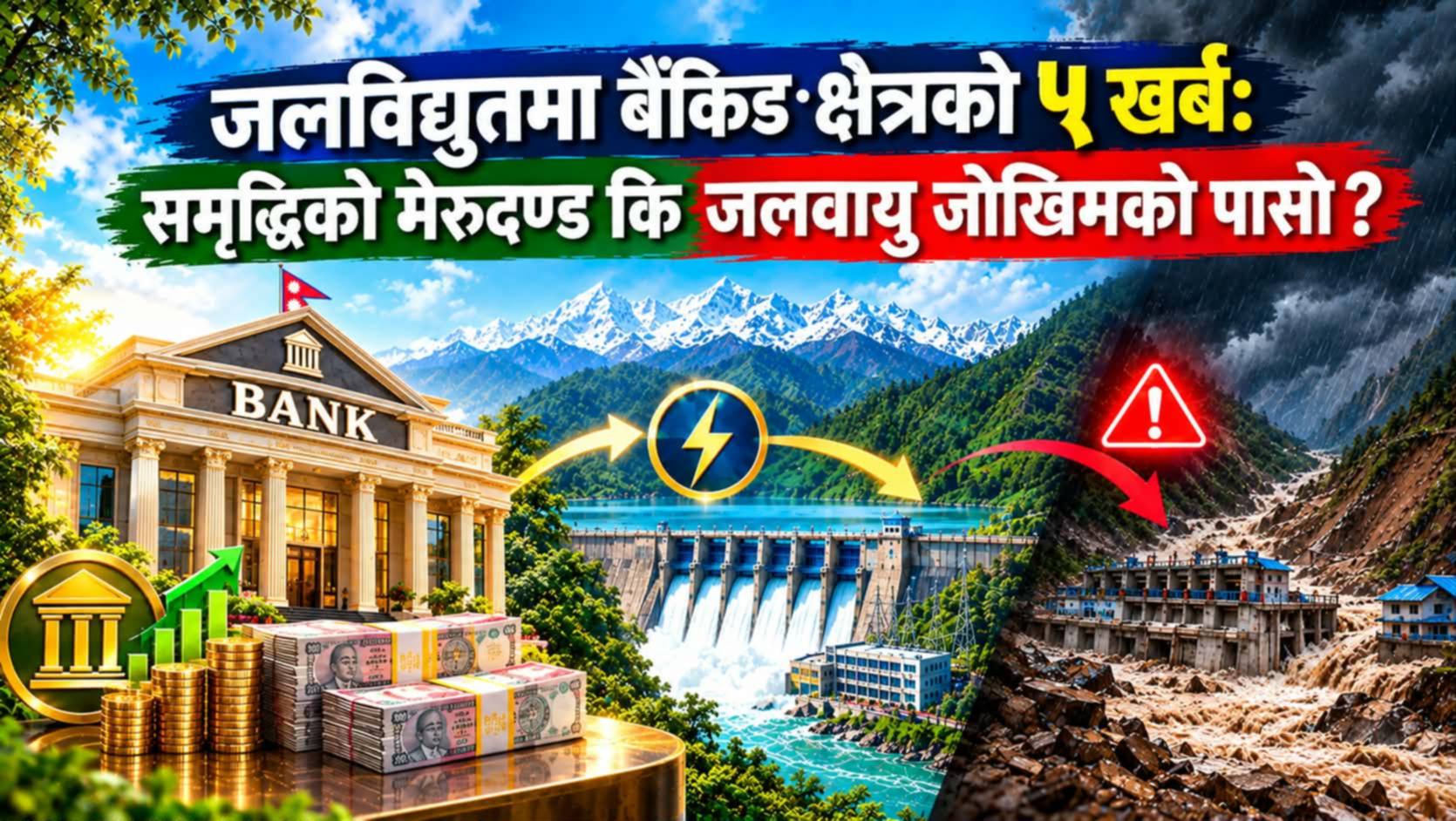

Kathmandu. The climate crisis has directly hit the banking investment of more than Rs 5 trillion in the streams. Investment agreements worth billions of rupees, which consider hydropower as the backbone of prosperity, are proving to be as weak as a deck of cards in the face of changing weather, devastating landslides and mudslides in the Himalayan region.
With the closure of projects due to natural disasters and the stalling of principal and interest payments, this crisis has now reached a dangerous juncture that will swallow the entire financial stability of the country and not just the energy sector. Nepal’s entire banking system has now reached a point where climate change is no longer just a matter of environmental discourse, but has directly collided with the financial stability of billions of rupees.



Banks and financial institutions have been aggressively mobilizing capital in the hydropower sector, which is the mainstay of energy security and economic prosperity. However, the extreme environmental uncertainty and sudden natural calamities that have been seen in such infrastructure based on the river system in recent times have pushed the financial investment of more than Rs 5 trillion to the brink of serious risk. The destruction of the physical infrastructure of the projects has had a direct impact on the loan recovery of the banks, the quality and liquidity of the assets.
The unprecedented damage caused to the hydropower projects in the Bhotekoshi River of Rasuwa district on August 10 has not only caused physical destruction but has also become a big policy warning for the banking sector.
The simultaneous destruction of dozens of projects with a capacity of more than 660 MW in operation and under construction proves that the engineering frameworks and traditional models of financial risk analysis are completely inadequate.
Not only this, the damage to financial institutions’ branches, ATMs, physical cash and human resources due to the floods has made it clear how wide and serious the scope of operational risk that banks have to face. When projects are stalled for a long time, manufacturers are unable to pay the interest on loans, which puts banks at risk of increasing their non-performing loans.
Experts say that although the possibility of glacial lake outburst was considered as the main risk while carrying out the feasibility and environmental analysis of hydropower projects in the past, now avalanches, dry landslides, uncontrolled sedimentary flow and cloud burst are emerging in the hilly topography.
Such emerging challenges have the potential to destroy dams, tunnels and power houses at any moment. This scope of financial risk is not limited to hydropower projects but extends to the roads, settlements and other commercial and vehicle loans flowing along the river. Experts say that due to the physical development and hasty construction done in the riverine areas ignoring the environmental impact, a situation has been created that a huge capital can be converted into zero in an instant.
According to the data of the Nepal Rastra Bank, commercial banks alone have disbursed more than Rs 503 billion in loans to the energy sector, which is more than 9.5 percent of the total loan investment. Some banks have more than 17 percent of their total loan portfolio concentrated in this sector. Although banks have expanded their investment in rivers and streams at a rapid pace due to the regulatory provisions requiring mandatory investment in the energy sector, the realistic assessment of climate risk has been very weak in proportion.
At the international level, the Basel Banking Supervisory Committee has put forward a clear framework for physical and transition risk disclosure, making climate-related financial risks an essential part of banking regulation, but in Nepal, it is still voluntary and at an early stage. Although the concept of green credit has been introduced, a strict and binding mechanism to protect banks’ balance sheets from the climate crisis has not been implemented.
Experts say that hydropower development should not be stopped due to increasing natural calamities, but there should be a radical review of the existing pattern of project construction and investment. The old designs based on the historical flow of the river, giving priority only to quick returns and cheap construction costs, are no longer safe in the era of climate change.
Banks should adopt a policy of giving financial approval only to underground infrastructure, alternative audit tunnels, safe power houses and climate-resilient structures that can withstand extreme floods and sedimentation. Such precautionary measures and technical precaution may increase the initial cost of the project somewhat, but in the long run, it will save billions of rupees in national wealth, investor capital and banking sector.
On the other hand, the recurrence of climate-related disasters is likely to increase the insurance premium and reinsurance cost of the hydropower sector in the future. If international and domestic insurance companies are reluctant to take risks or place strict conditions on high-risk river basin projects, the insurance system, which is the main basis of credit protection of banks, may be weakened. As a result, there is a risk that hydropower projects will be financially unviable in the future. The trend of limiting the environmental impact assessment to only the paper process and disregarding the natural character of the river may ultimately cost the overall economy of the country.
Nepal’s financial sector is at a critical juncture where it needs to find a balance between the aspiration for clean energy expansion and the harsh realities brought about by climate change. Experts say that in the coming days, it is imperative for regulators, energy promoters, insurance companies and financial institutions to jointly make climate risk a mandatory precondition for project evaluation.