




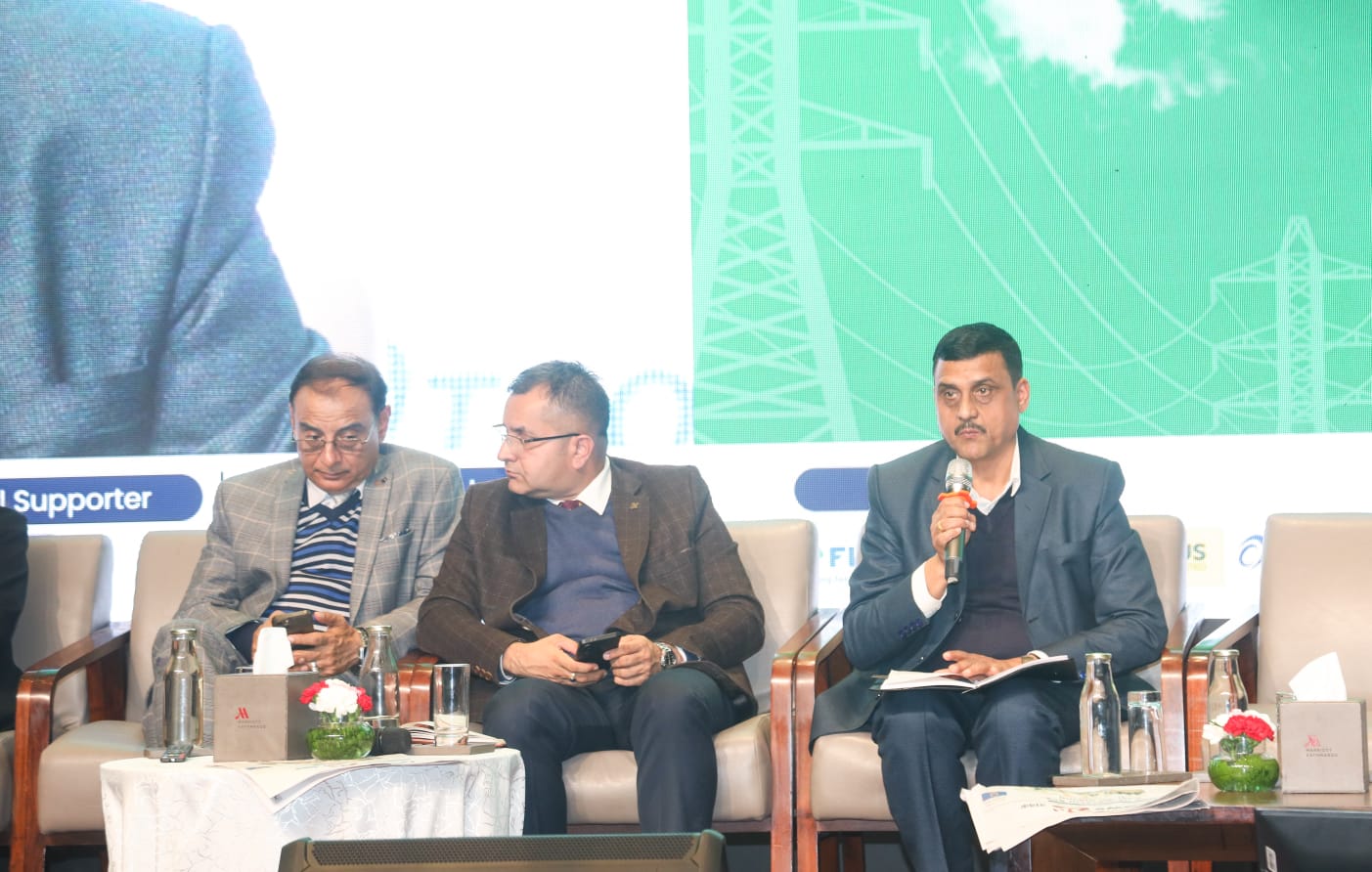

Kathmandu. Experts have said that the development projects will not be accelerated until the laws related to forest and environment are amended and facilitated. They pointed out the need of the Development Facilitation Act for the development of the energy sector.
On the occasion of the 26th establishment day of the Independent Energy Producers’ Association of Nepal (IPPAN), the Minister held discussions with experts on ‘Forest Bottlenecks in Energy and their Effects’. During the discussion, experts said that due to the problem of forest and land, the projects are not completed on time and the cost is increasing.



Prior to the panel discussion, IPPAN Executive Committee member Bharat Prasad Parajuli made a presentation. He made a presentation on the topic ‘Existing Laws Regarding Infrastructure Construction within the National Forest and Conservation Area’.
According to Parajuli, the energy projects would be the national priority projects of the country and the forest could be used for the same. According to him, the construction of infrastructure projects increases the forest area instead of decreasing it. It increases the amount of trees that need to be planted.
Parajuli pointed out the need of easing forest laws for the rapid development of energy sector.
The National Parks and Wildlife Conservation Act, 2029 has the authority to make rules. Parajuli said that it should be made development-friendly by using it. According to him, the Acts have paved the way for the construction of infrastructure projects in forest and protected areas in an environment-friendly manner.
According to him, the forest laws should be amended as they are being interpreted positively and converted into a discretionary right through regulations.
According to him, it is necessary to issue environment and infrastructure construction regulations to strengthen the national economy and create employment opportunities for Nepali youths in the country and to facilitate the construction of hydropower projects by maintaining the ecological cycle system within the forest and conservation sector.
Former secretary Krishna Acharya gave a presentation on ‘Balance in Energy and Forest Development’. According to him, the national parks and reserves are located in mountainous areas. Forest area is mostly used for the construction of energy projects. “Permission has to be obtained as per the National Park Act and Forest Act while developing the energy project. Forests and developers do not work separately. There should be cooperation,” he said. There should be coordination from the beginning. ’
According to Acharya, development works should be carried out by looking at the biodiversity hotspots of the protected areas. It should not be strict. “You can’t do it without development. Development should be done by protecting the environment,” he said, adding, “Ecological stability is necessary for long-term economic development.” ’
According to Acharya, 1 megawatt of hydropower can absorb carbon equivalent to 200,000 trees. There are many benefits of renewable energy. Hydropower is the main reason for the decline in petroleum imports. “EIAs are made only for approval. Environmental factors add to the safety hazards of the project. The country has to bear the brunt of the loss of nature,” he said. You have to work well and make a report. ’
IPPAN CEO Bhim Gautam moderated the panel discussion. Energy expert Arun Subedi said that the first condition is rapid development. He said that sustainable development should be followed by rapid development. He said that there is a problem in carrying out development works in Nepal due to lack of economic literacy. “The biggest problem with the bureaucracy is the terror of the regulatory agencies,” he said. According to him, they do not try to work saying that they have to fill 16 pages.
Mandevi Shrestha, director general of the Department of Electricity Development, said that the survey license period will be 5 years. “We give a 5-year survey license. 2 projects got survey licenses. He studied. But he could not get permission from the forest. They did not apply for the generation license and it was revoked,” she said. The report should be submitted within 2 years of the approval of the work list and scope of work. The report has also been decided again. ’
Shrestha said that the problem was due to extensive discussions with the forest bodies and differences in understanding between different agencies while making the Act and Rules.
Joint Secretary of the National Planning Commission, Arjun Bhandari, said that the work of the commission is coordination. According to him, the energy sector is the main basis for the development of the economy. The per capita consumption of 700 KW by the end of the 16th plan has been targeted. “During the tenure of most of the ministries, the projects could not be completed because of the issues of land and forest sector. It’s not just hydropower, that’s why most of the ministries are facing problems on time,” he said.
According to Bhandari, it usually takes 339 days to complete an EIA and 90 days to complete an IE. “There is a 40-day deadline for IE in India. The EIA has to be completed within 105 days. Malaysia, Australia EIA does not take more than 5 months. It will take a lot of time in Nepal,” he said.
According to Bhandari, the construction of Kathmandu-Tarai Madhes Fast Track began 7 years ago. “We have not been able to get the land. Forest clearance is pending. It may take another 6-7 years,” he said, adding, “Forest approval has been obtained by formulating a national priority plan for the three-room school.” It took 9 months. ’
He said that the development facilitation act should be brought. He said that there should be a one-door system.
Deepak Gyawali, joint secretary at the Ministry of Forest and Environment, said they were not aware of the delay due to lack of submission. “There are certain processes. There are aspects that need to be improved. It takes time,” he said. The format of the EIA is the same for land acquisition and permission to cut trees. All types of events should use the same format. It has to be made different according to the project. Most of the things have to be sorted out by IE. That’s where we are starting with the Forest Regulations. ‘
Secretary at the Ministry of Forest and Environment, Dr Govinda Prasad Sharma, said the laws were gradually becoming infrastructure-friendly. According to him, the environment protection regulations are being forwarded soon. “We will take it forward by holding discussions with development partners. There are some issues that need to be simplified. Let such a body do an EIA, tomorrow there will be no problem with the documents it approves. If there is no such manpower to give to the state, then there will be a situation of suffering tomorrow. It should be given in a sustainable and non-problem-free way,” he said, adding, “The issue of Dudhkoshi was stopped for 6 years without coming to the Forest Ministry.” Why are you holding it back? Why was the last one sought,” he said. There is a need to monitor whether the conditions are being complied with or not. ’
He added, “It is not enough to change the laws and regulations. Laws should be made after looking at the impact on implementation. ’