




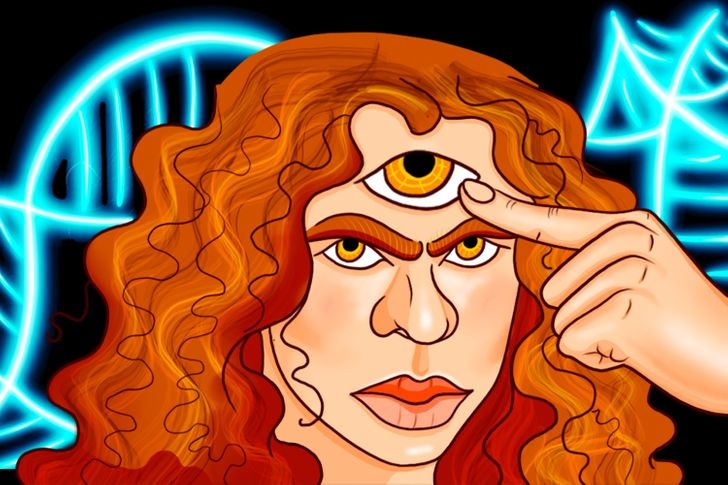

Kathmandu. Scientists have recently made an amazing discovery. Scientists have discovered that humans also have a third eye. The pineal gland in the middle of our head is actually a relic of the ancient ‘third eye’. Its job is not only to look at it, but also to regulate sleep and our body clock.
According to a research paper published in the journal Current Biology, researchers from the University of Sussex and Lund University claim that millions of years ago our ancestors had a middle eye. Over time, it developed into the pineal gland. This discovery tells us a new story about the evolution of our eyes and body clock.



About 500 million years ago, our ancestors lived in the mud and dark depths of the ocean. The eyes on the two sides of these creatures gradually lost their function as they became useless in the dark. However, they had a special structure in the middle of their heads – what the researchers have dubbed the ‘overall ancestral middle eye’. This central eye helped detect light, distinguish day from night, and set direction.
When these creatures started living in the tunnels, they lost their side of the eye but retained the middle eye. Because it was necessary for their vision. According to researcher Professor Tom Baden, over time, the parts of this central eye moved to two sides. It became the retina of our present day. The middle part became the pineal gland.
What TAG_OPEN_strong_38 does the pineal gland do today?
Today, the pineal gland is a small organ located in the middle of our brain. It no longer perceives light directly, but receives information about light and darkness from both our eyes. Its most important role is to produce a hormone called melatonin.
At night, the pineal gland releases melatonin. Which tells the body that it is time to sleep. It regulates our circadian rhythm, the 24-hour body clock. It affects not only sleep but also affects the reproductive system, immune system, mood, and body temperature. This hormone is produced less during the day. So we can keep on the watch.
Did the retina come first or the eye?
Researchers believe that the retina developed before the eye. Professor Tom Baden explained that it was important to distinguish day and night in deep water or mud and to know the directions up and down. The eyes on the side disappeared. However, the middle eye remained because it was designed for this purpose.
This study did not do new experiments. The researchers analysed genetic data, fossils, and existing studies of fish, lampreys, and other organisms. The result was that our eyes and pineal glands did not develop separately but developed from the same ancient structure.
The third eye is still seen in some organisms
This third eye is still clearly visible in some organisms. A prime example is the New Zealand reptile called the tuatara. It has a small eye on its head. These include the lens and the retina. It cannot see in detail but detects changes in the light coming from above. This helps the tuatara to distinguish day from night. He decides to bathe in the sun or hide.
pineal gland and spiritual beliefs
}
Since ancient times, the pineal gland has been given special importance. Greek physicians knew about it thousands of years ago. In Hindu and yogic traditions, it is called the ajanna chakra or the third eye. Awakening in yoga and meditation is said to bring insight, intuition, clarity and spiritual knowledge.
However, science has not yet been able to prove these spiritual powers. According to scientists, this organ is especially responsible for biological functions such as sleep and hormone regulation.
This research tells us that evolution is not always linear. Some old structures don’t disappear completely. However, new forms remain in our body. The pineal gland is proof of this. It can help in understanding sleep disorders, depression, and hormonal problems.
The pineal gland hidden inside our head is not just an ordinary gland. It is a living proof of a 500 million year old story. When our ancestors lived in the dark sea with one eye. Today it helps us sleep, regulates our mood, and keeps our body’s internal clock in check. –Agency