




Kathmandu. It has come to light that established industrialists and reputed business houses have embezzled billions of rupees in loans of banks and financial institutions, strongly attacking Nepal’s financial sector and corporate governance.
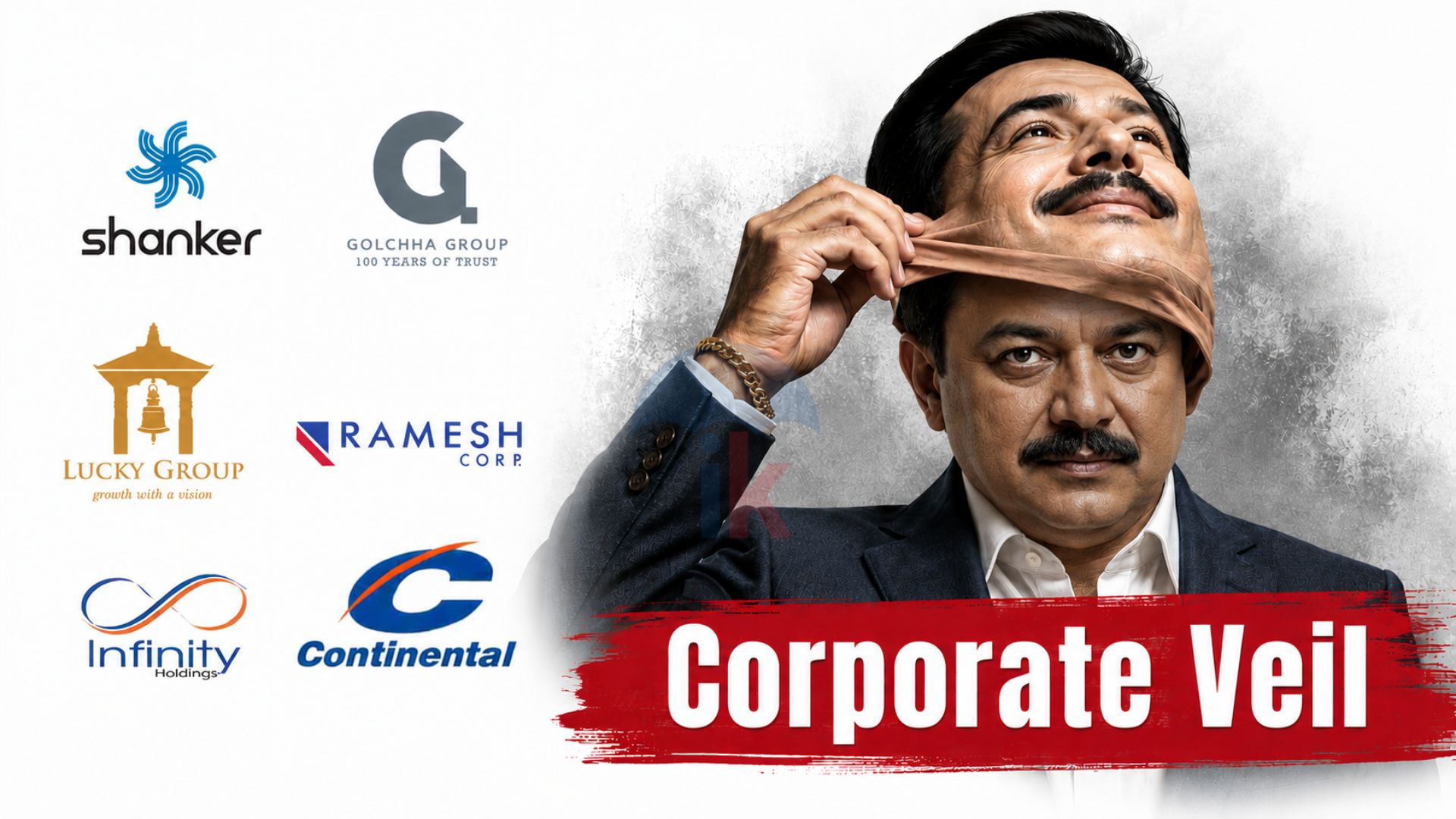
Promoters have made the corporate veil a strong weapon for financial crimes, taking advantage of the gross negligence and collusion of regulatory bodies such as the Insurance Authority of Nepal (NIA) and the Securities Board of Nepal (SEBON). A consolidation of the five cases of corruption and financial misappropriation that have come to light recently shows that key persons including Deepak Bhatt, Shulabh Agrawal, Shahil Agrawal and Shankarlal Agrawal have misused financial channels to make illegal investments and misuse of power in dozens of institutions including five micro insurance, two reinsurance, one life insurance, one reinsurance broker and one stock broker company.


What is it?
According to its historical background legal principles, the company is a separate legal person. The legal status of the company and the promoters or shareholders of the company are different. The personal assets of the promoters are not liable for the business, profit or loss of the company and legal liability. This impenetrable legal wall between the promoter and the company is called the ‘corporate wall’.
The theory was historically traced back to the famous Salomon v. Salomon & Co. Ltd. (QB). Kbyiel 7 R. The best. 1897). Where the court interpreted that the company and its directors are separate entities. However, when promoters misuse this legal wall to make the company a vehicle for fraud, tax evasion or bank loan misappropriation, the court breaks down that wall and liable for action. In this way, the process of removing the legal veil and punishing the real criminals or beneficiaries hiding inside is called lifting or piercing the corporate veil.
}
In the judicial history of Nepal, the Supreme Court had set a historical precedent by explaining the principle of corporate veil in the much-discussed case of Unity Life Assurance.
Unity Life had defrauded the public of billions of rupees through its illegal networking business by creating a cover of insurance and health services. At that time, the Supreme Court had clearly set a precedent through the judgment, “The cover of the company is to protect the business, not to hide the crime.” If the company is involved in defrauding the public, committing acts against the law, or committing financial crimes, then the court should dismantle the corporate well and hold the directors and promoters behind it personally accountable and liable to punishment. ’
Jagadamba Steel & Himalayan Rico Dangerous Fund Mobilization
The case of banking fraud and financial misappropriation registered in the commercial bench of the Patan High Court shows that the ‘corporate well’ has been abused in the style of Unity Life. According to a report conducted by the Central Investigation Bureau (CIB) and the Bank Supervisory Department of Nepal Rastra Bank, Jagdamba Steel, a subsidiary of the Shanker Group, had taken working capital loan and short-term loan from various consortium banks under the aegis of Nepal Investment Mega Bank for operating the industry and purchasing raw materials.
However, Shahil Agarwal, Shulabh Agarwal and Shankarlal Agarwal used Jagdamba Steel’s commercial credentials and corporate cover as just a fund channel. Out of the loan amount taken for the purpose of the industry, Rs 545 million was transferred to the personal account of Siddhartha Bank of Deepak Bhatta by showing fake and fake money for the purchase of 54 ana land in Sanepa, Lalitpur. According to the indictment filed in the court, the investigation has been done to confuse the financial system.
First Level: The loan amount was transferred from the bank account of Jagdamba Steel to the personal account of Deepak Bhatt.
Second Level: The amount was transferred directly from Deepak Bhatt’s personal account to the account of Infinity Holdings Pvt. Ltd., which is owned by him.
Third Layer: 450 Million was paid to purchase the promoter shares of Himalayan Reinsurance Company in the name of Infinity Holdings. That is, the loan taken from the bank to run the industry was used to buy the promoter shares of Himalayan Reinsurance by turning it through the corporate cover of Jagadamba Steel. The real owner and source of which was the bank’s bad loans.
Jagdamba Stillsko loan default
}
In order to hide the loan misappropriation, Jagadamba Steel had misled the regulatory body by showing it in its financial statements for 3 years by showing it as the amount of land in the bank. Later, after the investigation started, an attempt was made to cover up the financial crime by showing that the money was transferred from the personal accounts of the Agrawal family members (Shulav, Shahil, Shankarlal, Krishib, Shubhi and Jana Agarwal) to the accounts of Deepak Bhatt and returned to the account of Jagdamba Steel.
Negligence of the regulatory body{
}
This syndicate of promoters and extreme abuse of power is not limited to just one reinsurance company. Due to the inaction, helplessness and possible collusion of the Nepal Insurance Authority and the Securities Board of Nepal, the entire insurance and capital market has reached the grasp of the promoters. This institutional crime has had a direct and serious impact on the following institutions: It has been proved that the investment of companies like Himalayan Reinsurance has been established on the foundation of bank loan misuse and artificial corporate wells. This has brought down the credibility and credibility of the entire reinsurance sector in the international market, including another reinsurance company.
Five Micro Insurance Companies: } Even in the five micro insurance companies established for the protection of the general public and low-income citizens, these promoter groups have been misusing financial channels and diverting the insurance premium amount of the general public for their business interests in the guise of illegal shares and power.
A life insurance company: In the life insurance sector, these mafia promoters have increased the risk of diverting the life fund of the public for the future by hiding the corporate cover of their business house and diverting it to other businesses.
A Reinsurance Broker and a Stock Broker: In order to control both the insurance and capital markets, promoters conduct insider trading and share cornering through reinsurance brokers and stock broker companies licensed by the Securities Board. Regulators have not meticulously examined the fit-and-proper test of promoters and the source of actual investment, while industrial credit insurance and stock market licenses are being used to kill and corner shares.
According to the chargesheet, defendants Deepak Bhatta, Shulabh Agrawal and Shahil Agrawal have been found guilty of misappropriation of loans under Section 8 of the Banking Offences and Punishment Act, 2064 and Shankarlal Agrawal has been fined Rs 421.4 million and sentenced to 6 to 8 years imprisonment.
Apart from this, the investigation against them is also going on in the Department of Money Laundering. To save Nepal’s financial sector from collapse, the court now needs to completely dismantle the corporate valuation of companies like Jagdamba Steel and Infinity Holdings, reviving the precedent set in the case of Unity Life.