




Insurance companies are moving away from the traditional business model of business expansion, regulatory compliance, and managing the minimum required capital separately to a business model that combines risk tolerance, risk pricing, business capital, reinsurance, diversification of investments, etc. into a unified decision-making process.
The main reasons for the change in the traditional business model of the insurance business are the change in the nature of risk, the development of the regulatory body’s expectations, the changing needs of the customer, the need for capital, the increasing order of disasters and risks, the change in the investment environment and the increasing competition in the insurance market. All these reasons seem to be necessary to change the role of insurance with the changing risk.



Business Model
The insurance company formulates various strategies and plans to achieve its business objectives and goals. The insurance identifies the market and the customer. Accordingly, it makes products under different portfolios for the utility of the customer, and some are also formulated by the regulator. In the case of non-life insurance, there are various prevalent portfolios such as property, motor, engineering, miscellaneous, agriculture, etc. It also includes different types of products.
These products enter the insurance market mainly through the market department and agents. These are the main sources of income of insurance, while ‘insurance’ is a contract between the insurer and the insured, the main point of this contract is the underwriting while the other sources of income include investment and reinsurance commission.
‘Investment’ is done by insurance companies in various sectors. For example, bonds or bonds, fixed deposits, shares, debentures, agricultural production, storage and distribution of agricultural products, solar, energy and other sectors can be done as mentioned in the ‘Investment Directive’.
If the ‘liability’ that comes from the insurance contract as an expense in the insurance sector is the payment of the claim, then the insurance has to pay the ‘reinsurance fee’ for the rest of the ‘reinsurance’ by keeping a certain limit according to its financial capacity. Apart from this, there will be other management expenses. These are the main stages of insurance and this is how the insurance cycle operates.
In recent years, natural disasters and man-made disasters have been occurring one after the other, so there is a need for proper risk management.
Changing Risks and the Challenges of the Insurance Business
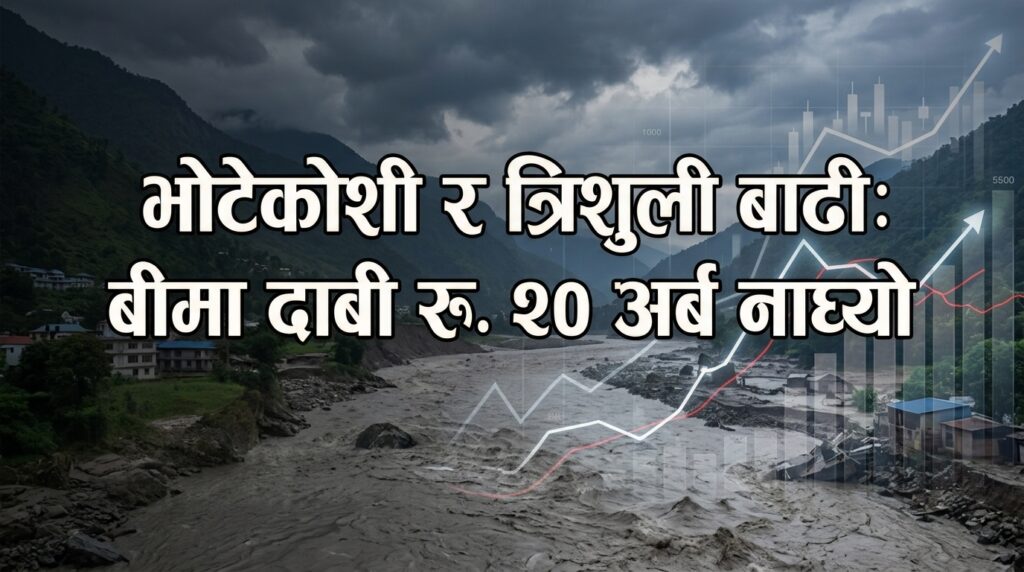
Ours is a country with a unique gift of nature. Similarly, nature itself is also challenging. The human and material damage caused by the recent ‘Bhotekoshi floods’ is an irreparable loss for all. The bitter reality is that the general public, the state and the insurance sector, especially non-life insurance, have been affected the most.
During this time, the views of various learned personalities who came to the media were heard and understood. According to them, there was a complaint that ‘scientists were not included in the construction of physical infrastructure’. What is the reality? When the issue of climate change is being raised from all sides, what should be the necessary steps to mitigate it? Are we really serious? This question has now become important for the insurance sector whether scientific studies, geography, flood and seismic risk have been adequately included in infrastructure construction.
‘Insurance’ is no longer just a means of compensating for the risk. It has become an important basis for the stability of the economy, financial security and long-term development. Therefore, the time has come to give priority to insurance, understand its wider role and importance and take forward policies and practices accordingly.
Environmental Impact Assessment, which is studied and researched in the course of physical infrastructure. Which is a very important report for insurance and it sets the appropriate basis for risk assessment. It provides information about the possibility of flood risk, soil conditions, earthquake probability, etc., and it helps the insurance companies to determine the insurance premium, mandatory premium, other conditions, especially in the non-life direction. As a result, it provides transparency between the insurer and the insured.
Similarly, the risk assessment used by the insurance company also includes hazard map, historical loss data, exposure data, geographical concentration, engineering surveys. The better we identify the risk at an early stage, the stronger the chances of reducing the financial loss will be because it is necessary for the insured to be aware of the loss other than the loss that the insurance can incur, so a partnership relationship is established between the insured and the insured.
The non-life insurance sector is bearing the brunt of one natural disaster after another every year. Preliminary assessments of the damage caused during the floods of September 2081 and the Jenji agitation of 2082 (of which the claim amount is around Rs. 23.20 billion according to preliminary figures) and the ‘Bhotekoshi floods’ are being assessed as more extensive damage.
The insurance business is considered as the ‘charioteer of disaster’ in the financial sector. Therefore, it is necessary for the state to come up with special policy and institutional plans to ensure the business continuity and financial stability of the insurance sector. Such initiatives not only contribute to the stability and development of the insurance sector, but can also play an important role in making the overall financial sector ecosystem more dynamic and strong. In this sense, it is necessary to see the strengthening of the insurance sector not limited to the insurance companies but also to the stability and development of the overall financial sector.
Prior to compliance: Company’s actual risk appetite
The insurance sector is developed, promoted and regulated by the Insurance Authority of Nepal. Therefore, there are various types of guidelines and directives for the insurance sector and the insurance sector is also following the mentioned rules. However, it can be estimated that the concept of ‘real risk capacity of the insurer’ may have been developed as the minimum capital, compliance and policies of the regulator are not enough when the nature of risk is changing over time. This is because it is difficult to distinguish between the real risk between the strong and weak institutions when the regulator prepares the same criteria.
It is necessary to meet the minimum standards of the regulator but it cannot automatically determine the particular risk profile of the company. Therefore, since the insurance company cannot take into account the actual risk of the company, a risk-based approach that can identify, measure and manage capital in accordance with its business, risk and risk bearing capacity seems inevitable.
Risk Identification, Evaluation, and Outcome Determination
The potential financial impact that may arise from any risk can be assessed within a certain time frame. However, the actual impact of the risk is not limited to the general situation only. Therefore, along with identifying and measuring the potential impact of the risk, it is necessary to set clear limits, criteria and the level at which the damage can be absorbed.
For the different types of risk profiles of insurance companies, a basic question arises: “How much risk can a company take according to its capital and risk appetite?” To find an answer to this question, it is necessary to determine the necessary parameters and parameters, taking into account various aspects including the nature of the risk, the potential impact and the risk capacity of the company. These aspects are the appropriate basis for risk management.
Risk assessment is mainly done in two ways, qualitative and mathematically. It is not possible to measure all risks mathematically alone. Some risks have to be qualitatively evaluated on the basis of the nature of the risk, the potential impact, the state of control and the available data, while the risk can be measured mathematically when sufficient data is available. Therefore, proper use of both methods is necessary for effective risk management.
In this regard, whether the company has the capacity to withstand the potential losses even in the most adverse conditions. In such a situation, whether the continuity and financial stability of the business is maintained or not? Stress test and scenario analysis are important tools to test this. It goes beyond measuring the risk of the normal situation and helps to evaluate the financial capacity, risk bearing capacity and continuity of the business in the face of adversity.
Relationship between assets and liabilities
The first liability of the insurer is to pay the claim for the liabilities it assumes. For this, it is not enough to have enough assets with the insurance company. It is equally necessary to manage these assets in such a way that the liabilities are created and the necessary amount of liquidity and cash flow is available at the time of payment of the claim. Therefore, there is an important relationship between the assets and liabilities of the insurer.
In the insurance business, liabilities can be created in large quantities at a given time. For example, due to natural calamities, major accidents or other catastrophic events, there may be many claims at once. In such a situation, if the required amount is not immediately available for claim payment, the liquidity and financial condition of the insurance company may be strained. Therefore, the imbalance between assets and liabilities needs to be seen as an important aspect of the overall risk management of the insurer and not just as a matter of accounting or financial management.
In this context, is it not appropriate for an insurance company to manage its investments only for the purpose of achieving short-term returns? It is necessary to determine the duration and structure of the assets by taking into account the nature of the liability, the timing of the expected claim payment, the need for cash impact and the potential risks. Such management helps to provide the necessary financial resources at the time of claim payment.
In addition, market risk, interest rate risk, and other financial risks can also have a significant impact on asset and liability management. Changes in interest rates or market prices can affect the value and return of an investment, while if it does not match the change in the value of the liability or the cash effect, the imbalance between assets and liabilities can increase further. Therefore, it is necessary to evaluate not only the returns but also the duration of the liability, cash flow and risk when making investment decisions.
Portfolio Management Requirements
}
In the risk management of an insurance company, along with the management of assets and liabilities, proper management of various insurance portfolios and products is equally important. The nature of each product’s risk, the frequency of claims, the size of the claim, the period of claim generation and the possibility of renewal are different.
Some portfolios or products are likely to create a sequential liability over a long period of time, while some are likely to incur a large amount of losses at once in the event of a special event. Therefore, it may not be appropriate to manage the portfolio or product from the same point of view. Depending on the characteristics of the risk, proper coordination between risk taking, reinsurance, investment and capital management is necessary.
In this way, if the right balance is maintained between assets, liabilities and insurance portfolios, the insurance company will be able to increase its ability to manage the pressures caused by unforeseen claims and financial risks. This overall risk management can not only enhance the financial stability of the insurance company but also its ability to achieve long-term business success and sustainable profitability.
catastrophe and accumulation{
}
The consequences of any type of risk, especially the frequency and severity of the damage. The nature of the insurance business is to manage such risks well. Normally, these types of claims are received by the insurance companies and although it is not a new issue for insurance, the situation becomes serious when a catastrophe and accumulation occur simultaneously. Take the case of earthquakes for example. If a company has issued 100 property insurance policies (fires under property insurance, natural disasters, etc.), the damage caused by the damage such as the insured factory is completely damaged due to fire and even if the damage is estimated to be fifty crores, it will not affect the insurance company to pay the claim financially. It may not matter if another such thing happens, but if 70 out of 100 issued insurance policies are damaged due to an earthquake in one of the insured areas, then it is definitely a serious issue. The damage caused by risks like earthquakes, floods is called a catastrophe and the most complicated thing is that it happens at the same time and in the same geographical area. This is challenging for the insurance company.
In recent years, the risk of floods has increased. Hydropower that is constructed in the same river also promotes accumulation. Insurance companies need to be aware of this.
At the policy level, there is a need to study and research on basic and serious topics such as disaster modeling, geographical concentration, stress test, scenario analysis, adequate reinsurance.
Reinsurance: Risk transfer protection mechanism
}
Insurance provides reinsurance both theoretically and strategically. There is a rule that the insurance company should reinsure the rest as much as it can hold according to its financial condition and capacity. However, if the reinsurer itself is weak, then the insurance company may be in trouble. Therefore, it is also necessary to constantly monitor the credit rating of the reinsurer (the financial capacity of the reinsurer).
Issues such as the structure of reinsurance, the gap between the catastrophe and the reinsurance are important, and the insurance company may also bear the burden of the restatement charges after the reinsurance.
Reinsurance is not only a means of transfer of risk, but it can also be said that it is a proper means of continuity of the business of insurance, protection of capital, liquidity management.
Roadmap Now: From Paper to Decision Process
The Risk Roadmap is not only a clear direction for the insurance sector to comply with regulatory body regulations but also to set business goals such as capital management, risk profile and risk holding capacity.
Ultimately, its success will be important not only in the roadmap on paper, but also in how effectively it is used in business decisions and day-to-day operations. Similarly, a risk-based insurance system is not only about adding a new reporting framework, but also about how and why a company accepts risk, how much capital it retains, how it values products, how it re-insures, where it invests, and how much damage it can sustain even in the face of an unforeseen crisis.
Therefore, the issue of business continuity and profitability cannot be properly pursued without a comprehensive review of the present and future risks by limiting the insurance company to compliance only. If the insurance company takes a decision by taking a decision by taking into account the changing risks, its financial capacity and the impact of potential future risks, then the risk-based system will be the necessary roadmap for the future.