



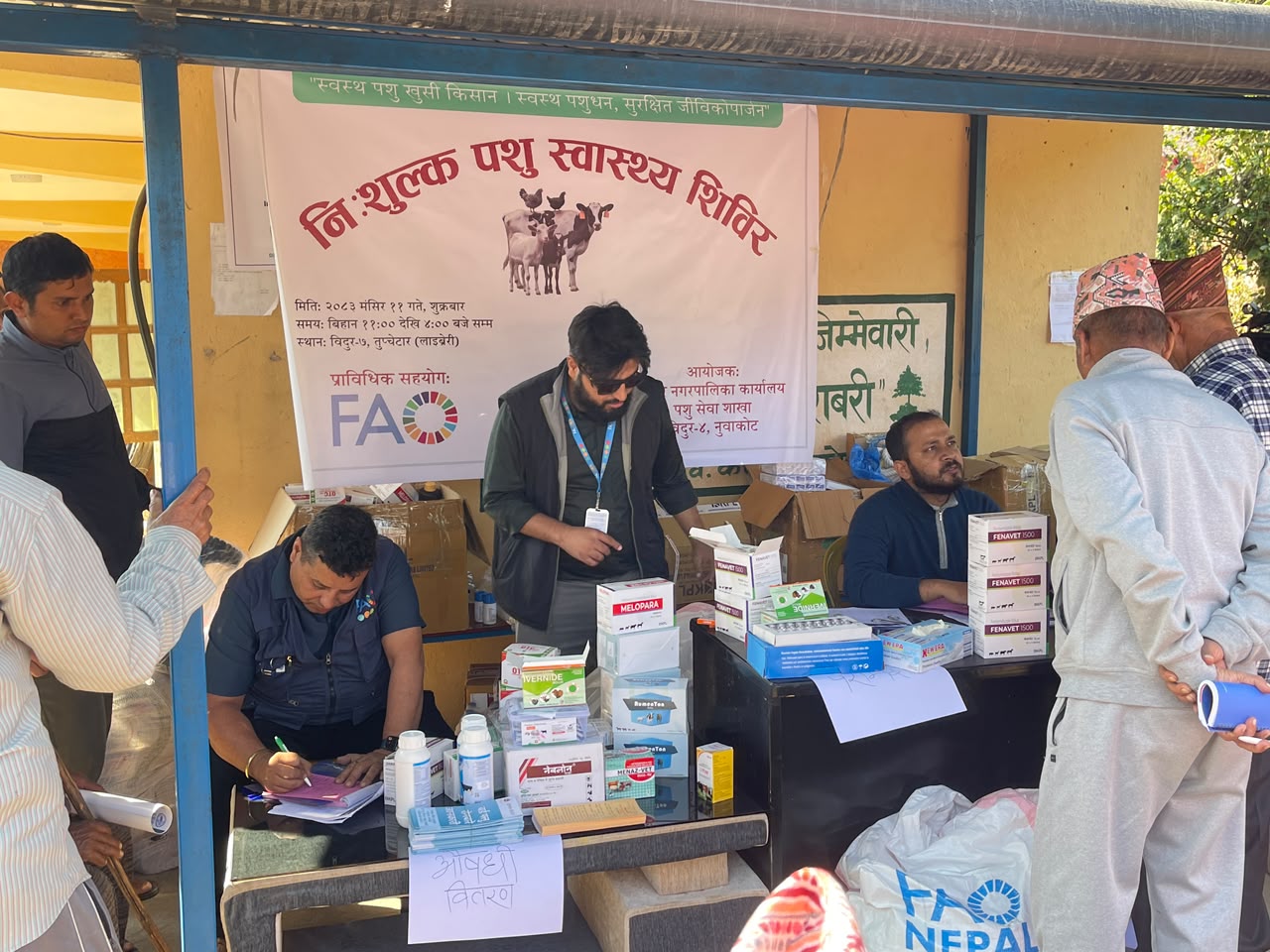

Kathmandu. A free animal health camp has been organized since Friday in Vidur Municipality, Nuwakot, targeting the health treatment of livestock affected by the floods and the restoration of the livestock sector. The camp was organized with technical assistance from the Food and Agriculture Organization (FAO) Nepal and the Vidur Municipality Animal Service Branch with the slogans ‘Healthy Animals, Happy Farmer’ and ‘Healthy Livestock, Safe Livelihood.’
In the camp being conducted in the Vidur Municipality area, health check-ups, treatment, and necessary medicines are being distributed to livestock raised by flood-affected farmers. The camp was organized targeting livestock injured after the flood and affected by various health problems. The program was conducted in collaboration with FAO Nepal and the municipality to provide animal health services to flood-affected areas.


Vidur Municipality Animal Services Branch Chief Dr. According to Sujata Adhikari, farmers contacted the municipality for treatment of about 40 rescued livestock after the flood. She informed that the municipality has deployed various technicians to treat the rescued animals. She said that some animals were treated themselves, while technical teams were deployed for others.
According to her, animal feed had previously been distributed to farmers affected by the floods in collaboration with various organizations. She said that about 200 sacks of feed were distributed targeting farmers in the affected areas, and free medicines were also provided to prevent a shortage of medicines.
Dr. According to officials, while collecting details of damage to livestock farms affected by floods in Vidur Municipality, records have emerged that five large goat, poultry, and cattle farms have been affected. Similarly, 330 farmers have reported damage to their livestock with the municipality.
For proper management of animals killed by floods, consumer committees have been formed at four locations in the municipality in collaboration with FAO Nepal. Work has already begun on managing dead animal remains in Vidur Municipality–5 and 10. In some places, after animal bones and remains were found, management is being carried out by spraying lime and non-infective medicines using necessary protective materials.
Since the remains of animals washed away by the floods can pollute drinking water sources and the environment, it is necessary to manage them scientifically. She said that once movement in the affected areas becomes easier, management work will be advanced in other areas as well.
After the damage to the livestock sector, the municipality is planning various options to rehabilitate farmers. Discussions are underway to connect farmers who raise cows and goats affected by the floods to poultry and pig farming as an alternative livelihood.
Dr. The official stated that while prioritizing human rescue and relief during disasters is natural, animal health and management must also be made an integral part of disaster management. He stated that due to the inability to prioritize budget and policy priorities for agriculture and livestock sectors, animal health services have not been able to expand as expected even at the local level.
She urged the government to remove sand, stones, and soil from cultivable land that could be reclaimed and to provide compensation to farmers who lost irretrievable land, saying that after the floods turned arable land into barren land.
FAO’s plan to run animal health camps in 15 municipalities
FAO Nepal’s Livestock and One Health Advisor Dr. Surendra Karki stated that the organization is collaborating with the Government of Nepal on tasks ranging from collecting details of the damage to livestock after the floods to treatment and managing dead animals.
According to him, after the floods, details of animal damage and injured animals were collected in coordination with the Animal Services Department and the local level. Necessary medicines were provided to the local level for the treatment of injured animals, and necessary supplies including lime and non-infective medicines were provided for managing the dead animals.
TAG_OPEN_p_33 He informed that teams have been formed by deploying local communities in all 15 flood-affected municipalities to search for and manage the remains of dead animals. He stated that in each municipality, a consumer committee was formed involving local farmers and communities, and scientific management of animal remains and bones is underway.
According to Karki, FAO Nepal plans to conduct at least one animal health camp in all 15 municipalities affected by the floods in the initial phase. Camps will be conducted in coordination with the animal service branches of the respective municipalities to identify areas of greatest need. He added that such camps will continue in the coming days based on needs.
He noted that the health of livestock is directly linked to human health and that if animals died during disasters are not properly managed, water sources can become polluted and pose risks to human health.
Since in a country like Nepal, dependent on agriculture and animal husbandry, livestock farming is the main source of livelihood, he suggests that disaster management policies and programs should include animal rescue, treatment, feed management, and scientific management of dead animals.
Emphasizing the need to restore livestock according to local needs for the restoration of flood-affected communities, he said that in some places, goats, buffaloes, chickens, or pig farming may be appropriate. He said that programs should be advanced in collaboration with the government, local level, and various organizations to restore the value chain linked to the production and sale of milk, eggs, and meat in the affected areas.
Local farmers praised FAO’s work
Local farmers participating in the camp said they felt relieved as free animal health services were available right in the village. Janaka Aryal, a local from Vidur Municipality-7, said that the program run by FAO Nepal helped the affected farmers. Kalpana Adhikari from Ward No. 7 also said that farmers benefited from the animal health camp.TAG_OPEN_p_27
Similarly, Bhojraj Nyaupane and Ramkrishna Sapkota from Vidur Municipality-7 also expressed positive views of the camp conducted to provide treatment to livestock affected by the floods and to assist farmers.
Tupche Camp Committee chairman Ramprasad Adhikari said that the program run by FAO Nepal in collaboration with the local level has benefited the common farmer. He stated that such programs will help farmers affected by floods to resume livestock farming.
FAO Nepal and Vidur Municipality have announced that they will continue their cooperation in the coming days, advancing programs for the health treatment of flood-affected livestock, management of dead animals, and restoring farmers’ livelihoods.