



Kathmandu. Nepal’s reinsurance policy has a clear and natural objective – to keep a large part of the insurance premium within the country, to reduce the outflow of foreign currency and to develop reinsurance capacity in the country. Through this policy journey, Nepal has come from a situation where there are no domestic reinsurers to two reinsurance companies today.
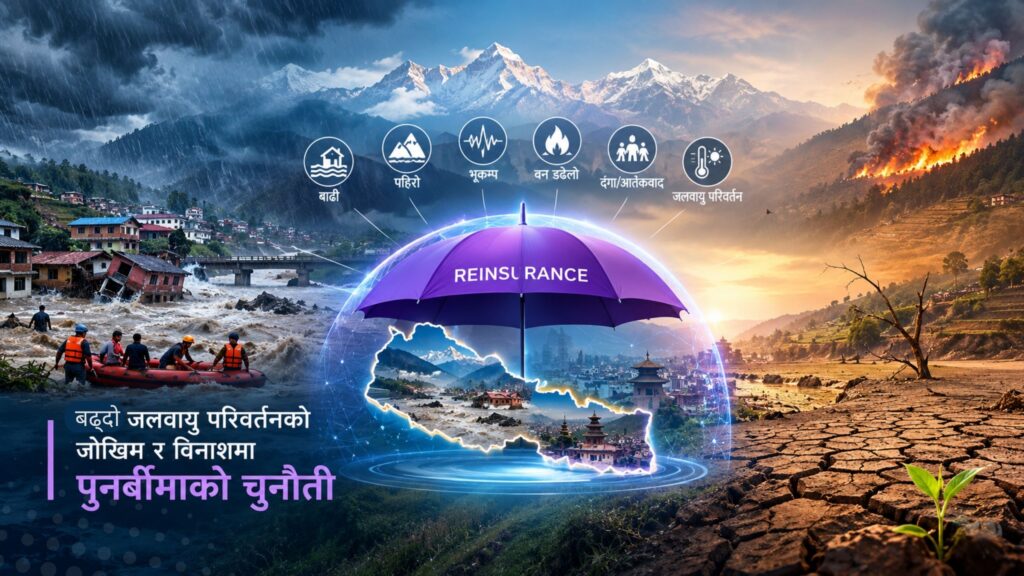
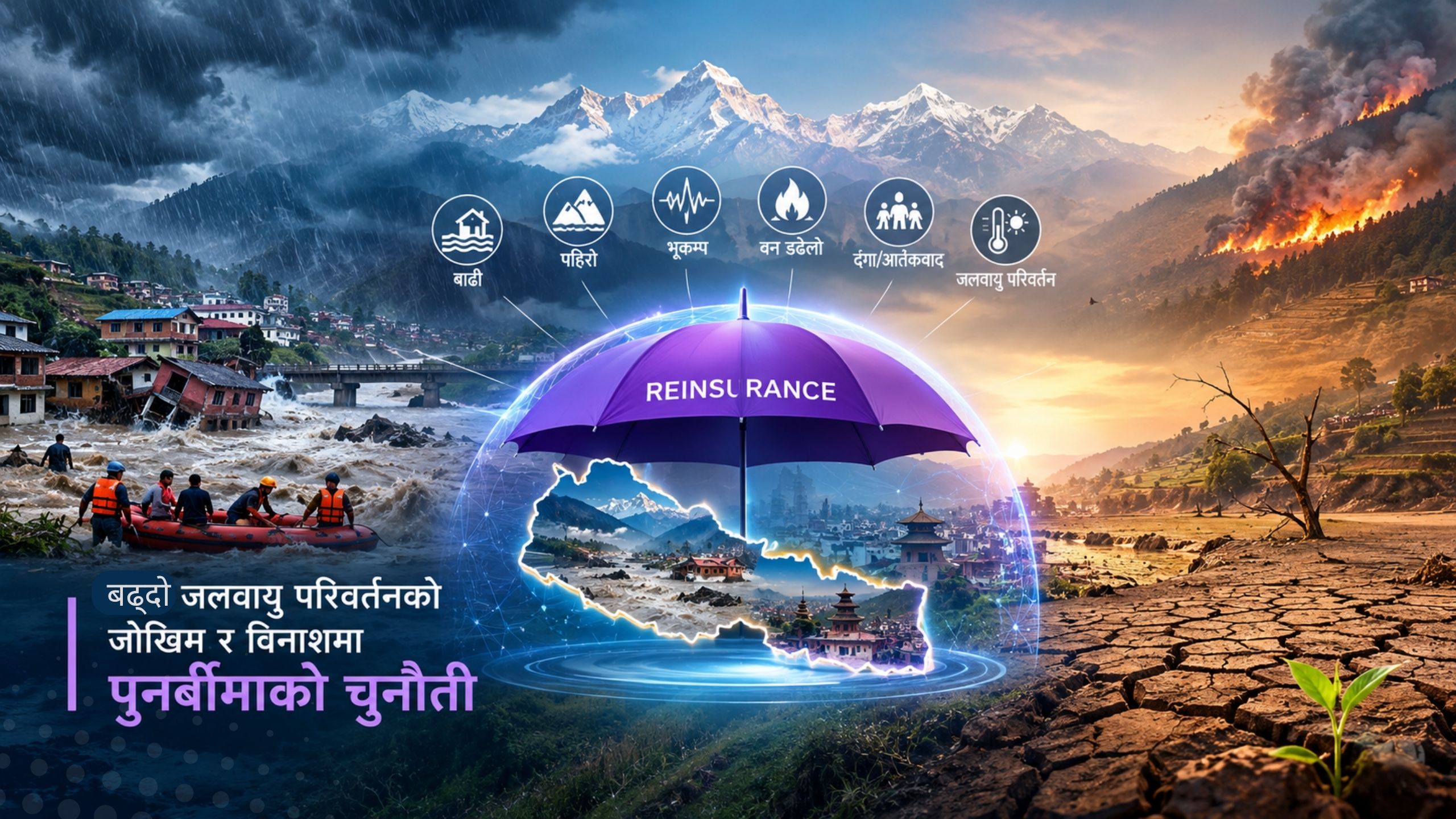
But after the Gen-G movement of 2025 and the Bhotekoshi-Trishuli floods of 2026, a different and more serious question has arisen: TAG_OPEN_strong_104 Should we measure the success of the reinsurance policy by how much insurance premium is in Nepal, or how much disaster risk Nepal can safely carry TAG_OPEN_strong_103 TAG_CLOSE_strong_104 with us?



To find the answer, it is necessary to understand the history of reinsurance in Nepal. The insurance bridge was established in Nepal in 2003 at a time when the reinsurance capacity for risks including terrorism was not easily available in the international market. Its main objective was to manage risks such as riots, strikes, malicious damage, destruction and terrorism. Later, in 2014, the government decided to convert this insurance bridge into Nepal Reinsurance Company Limited (Nepal Re). Therefore, there is a historical connection between the origin of Nepal Reinsurance Company Limited and such special risks.
But the market of 2003 and today’s Nepali insurance market are not the same. Currently, there are two domestic reinsurers in Nepal. The value of insured assets has increased significantly. Billions of rupees of risk is concentrated in large hydropower projects, industries, commercial buildings and other infrastructure. Therefore, it is natural that the reinsurance structure that was suitable in the past is still suitable in the same form or not.
The Insurance Act, 2079 has given the legal basis for domestic reinsurance. Under Section 81 of the Act, there is a provision to reinsure the reinsurer established in Nepal at the minimum percentage prescribed by the Nepal Insurance Authority. Its detailed implementation will be done through the guidelines issued by the Authority. The Insurer’s Reinsurance Directive, 2080 has undergone various amendments over time, including the fourth and fifth amendments made in 2026.
Looking at the direction of the original Reinsurance Directive, 2080, there seems to be a gradual reduction in the mandatory direct share. The direct share to be given to each domestic reinsurer was reduced from 10 per cent to 8, 6, 4 and 2 per cent respectively and there would be no such fixed direct share from the financial year 2084/85. The remaining treaty also provided that at least 30 per cent of the reinsurance should be offered to the domestic reinsurer. That is, the initial thinking seemed to be to move from compulsory allocation to capacity, competition and market-based reinsurance system respectively.
But after the budget of the financial year 2083/84, this direction changed. The government announced that at least 20 percent of the related insurance issued by the Nepalese insurer would be re-insured through the Nepal Reinsurance Company and the Nepal Insurance Authority implemented it through the fifth amendment of the Reinsurance Directive. However, air insurance, riots and terrorism and specified health, travel and trekking related businesses are excluded from the provision of this direct share.
This is the reason why the risks related to riots and terrorism cannot be mixed with normal direct reinsurance. Such risks fall under the separate provision of reinsurance in the country. It should not be considered as the same arrangement with the 20 percent direct share given to Nepal Re. Similarly, Nepal Re being the institutional successor of the old insurance pool and the current mandatory reinsurance system are not the same legal issue. These issues are certainly related to each other, but are technically and regulatorically different.
The Gen-G movement of 2025 put this issue to the test in practice. According to data based on data from the Insurance Authority of Nepal, there were 3,664 claims to insurers }, }, with a claim amount of about Rs 23.53 billion{{TAG_CLOSE_strong_100}. By June 2026, about 7.62 billion } had been paid. This amount is not the final insured loss. The final liability may be different as large claims are yet to be surveyed, evaluated and adjusted. But one thing became clear—a single event—civil unrest or rioting—could create thousands of claims for multiple insurance companies at once.
Less than a year later, the Bhotekoshi-Trishuli floods of August 26, 2026, posed another kind of risk. By the end of September, according to the available data, the estimated loss had reached Rs 20.98 billion {{TAG_OPEN_strong_98 TAG_CLOSE_strong_98}} from about 2,180 claims. This is also not the final adjusted claim. But over the course of about a year, Nepal suffered two major correlated losses of two different natures—one man-made and the other related to natural disasters and infrastructure. These two incidents are very useful real examples to test Nepal’s reinsurance structure.
It is important to understand a basic principle of reinsurance here— reinsurance does not remove the risk , } transfers the risk from one place to another.
Suppose each of the 10 insurance companies has an exposure of Rs 2 billion to the risk of being affected by the same calamity. If all these companies give most of the risk to the same domestic reinsurer, then the risk of Rs 20 billion will not be eliminated. It only transfers from the balance sheet of 10 different insurance companies to the balance sheet of one reinsurer.
Diversification occurs when common and unrelated risks are combined. But in an earthquake, a major flood, a riot, or terrorism, the situation is different. A single event can affect hundreds or thousands of insurance policies at once. In such cases, risk aggregation can sometimes become a risk concentration TAG_CLOSE_strong_94 rather than diversification.
Having two domestic reinsurers in Nepal is a positive development. It increases capacity and reduces the risk of relying on a single reinsurer. However, dividing the disaster risk within Nepal between two Nepali reinsurers does not lead to geographical diversification. For example, in the event of a major earthquake in Kathmandu, both insurers may be affected by different insurance companies and different risks at the same time.
So the main question is How much business will Nepal Ri or Himalayan Ri get ? It should not be . The important question here is—How much of the correlated disaster risks associated with Nepal can be safely borne by the combined capital of Nepal’s insurance and reinsurance sector ?
This is where the role of reinsurance comes in. Once a domestic reinsurer takes a risk from a Nepali insurer, it is not necessary to keep all the risk in its balance sheet. It can re-transfer the calamity risk beyond its capacity to the international reinsurer. In this way, the chain of risk goes from the insured to the insurer, from the insurer to the domestic reinsurer and from there to the international reinsurer.
Such a structure can serve two purposes simultaneously. Nepal can keep insurance premiums and risks within the country that it can sustain with its capital and capacity, while it can diversify into the international market for disaster risks that can be excessive or affect the system itself. This is the main objective of effective reinsurance.
The government’s budget for the financial year 2083/84 also seems to have acknowledged this balance to some extent. It also states that while providing 20 percent of the reinsurance in Nepal, a certain portion of the reinsurance will be shared with the foreign reinsurer to reduce the risk. Therefore, domestic reinsurance and international reinsurance are not competing concepts of each other. They are different layers of the same risk management system in proper structure.
There’s a very important difference here—keeping insurance premiums within the country and keeping all risk within the country is not the same thing.
The data on how much insurance premium the domestic reinsurer has received does not tell us where the risk has ultimately reached. The domestic reinsurer can accept enough business and transfer its extreme disaster risk out through international reinsurance. On the other hand, even if the objective of keeping the insurance premium in the country seems to be successful, the high disaster risk may also be stored within Nepal.
Therefore, from the regulatory point of view, the more important indicator should be Net National Catastrophe Exposure —Net National Catastrophe Exposure . In other words, after the retention of primary insurers, domestic reinsurance and international reinsurance, how much risk will ultimately remain in Nepal’s financial system in the event of a major disaster?
Modern technical means are available to measure this. Disaster modeling uses concepts such as Probability Maximum Loss (Probable Maximum Loss PML), Event Exceedance Probability (Occurrence Exceedance Probability OEP) and Overall Exceedance Probability (Aggregate Exceedance Probability AEP). With the help of these, different possible damage scenarios can be created at a level that can be seen once in 20 years, 50 years, 100 years, or 200 years. This does not mean that an event occurs exactly that many years later; It is a measure of the annual probability of damage being larger than a certain amount.
The OEP generally looks at the potential damage caused by the largest single event within a year, while the AEP looks at the total impact of the disaster damage throughout the year. By adding the geographical location of the insured property, the nature and intensity of the risk, the damage sensitivity of the structure, the terms of the policy, the insurer’s own holdings, reinsurance and reinsurance, the true economic impact of a major event on Nepal’s insurance system can be seen very clearly.
The Gen-G movement and the Bhotekoshi-Trishuli floods have given Nepal very useful real data for this. The Gen-G phenomenon can be used to study the risk concentration of riots, strikes, malicious damage and terrorism. Floods can be used to understand the concentration of hydropower, infrastructure, property, and geographical flood risk. Therefore, these events can be used not only as a matter of claim payment, but also as a basis for preparing TAG_OPEN_strong_81 a future national disaster risk model.
The mature reinsurance system should be layered. In the first layer, the insurance company carries the risk according to its capital and risk bearing capacity. The domestic reinsurer then accepts the risk by looking at its capital, solvency, technical pricing and overall portfolio. Disaster risks above the limits that Nepal’s financial system can safely sustain are diversified through international reinsurance and reinsurance. A separate disaster financial mechanism may be required for very rare but can affect the overall economy.
Such a provision is not intended to weaken the domestic reinsurer. Rather, it can strengthen the domestic reinsurer in the long run. TAG_OPEN_strong_80 A strong reinsurer is not one that carries as much risk as possible ; The strong reinsurer is one that correctly values the risk, }, and transfers excess risk effectively at a reasonable price.
Therefore, the debate on Nepal’s reinsurance should not be limited to the question of whether the mandatory share should be 10 percent or 20 percent. A certain percentage is an administratively easy measure, but the disaster risk percentage alone is not determined. The 20 percent risk of a geographically diversified portfolio and the 20 percent of hydropower projects in the same river system, assets concentrated in the same city, or correlated risks such as riots and terrorism are completely different.
The main question to be asked TAG_OPEN_strong_73 now is, what is the safe and TAG_CLOSE_strong_73}} of Nepal’s safe and self-contained disaster risk appetite?
The answer should be found through an analysis of capital, solvency, PML, OEP/AEP, geographic and regional risk concentration and reinsurance structure. Only then can a scientific decision be made on how to allocate that capacity between the primary insurer and the domestic insurer, and how much of the risk to diversify into the international market.
Nepal has moved from the insurance pool to the market of national reinsurers and then two domestic reinsurers. Now the next stage of the development of the reinsurance sector should be the journey from TAG_OPEN_strong_71 compulsory reinsurance based on a certain percentage to risk-based disaster supervision .
The basic principle is simple: Let’s keep the risk that Nepal’s insurance and reinsurance system can safely bear in Nepal{; But let’s diversify internationally the share that can put the entire system at risk during a major correlated disaster.
After the Gen-G movement and the Bhotekoshi-Trishuli floods, this issue is no longer limited to theoretical debates. TAG_OPEN_strong_67 The bigger question now than how much insurance premium Nepal has kept in the country is —} In the event of a major disaster, where does the burden of risk finally fall ?