



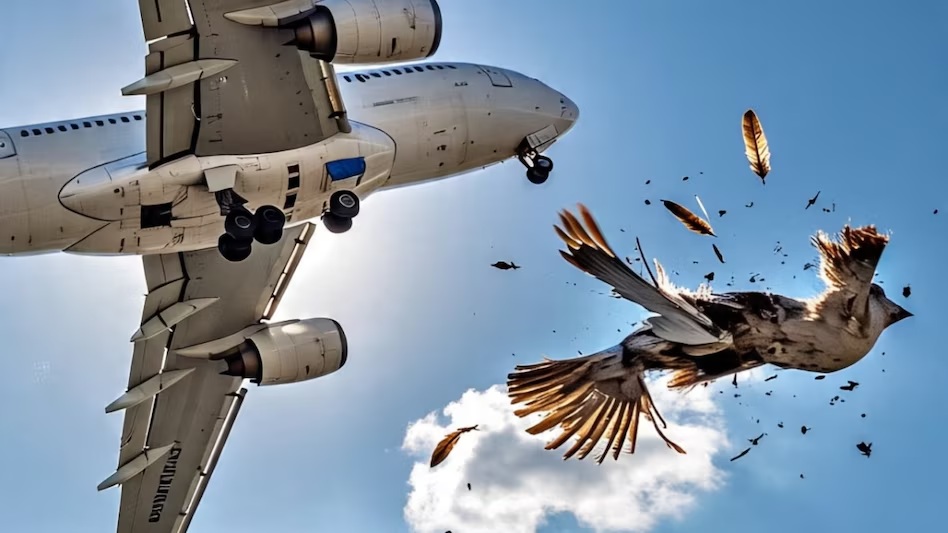

Kathmandu. When a small bird collides with a passenger plane, how does it destroy the heavy Airbus 320? An ordinary passenger plane flies in the sky at a speed of 200 to 900 kilometers per hour. It is a simple question that how can an aircraft flying at such a high speed be damaged after colliding with a bird weighing 500 grams, 1 kg or 2 kg?
Before considering this damage, know that an empty Airbus 320 aircraft weighs between 40,000 and 44,000 kg. The maximum weight of this aircraft can be 77,000 kg.



The incident of a bird colliding with a plane flying in the sky is called a ‘bird hit’. This can cause a lot of damage to the aircraft. In fact, this damage is not caused by the size of the bird, but by the combination of its speed and the high speed of the aircraft. The reason behind this is the energy generated from the speed of the collision and the force of the impact.
How does damage occur?
Now the same question arises that why is the damage caused by hitting such a small bird so terrible and devastating? It’s all a science game. When the bird collides with a plane flying at a speed of 200 to 900 kilometers per hour, the high-speed energy (Kinetic Energy = 1/2 mv²) is generated. There, ‘M’ means mass weight and ‘V’ means velocity i.e. relative speed.
Aircraft typically fly at speeds of 200-900 kmph. Therefore, even if the bird weighs only one kilogram, the energy is very high when it hits. For example, a 1 kg bird that hits a plane flying at a speed of 300 km per hour can generate a force of about 3400 Newtons. Which can be equivalent to a heavy hammer blow.
From another example, a 4-kg bird can generate a lot of energy when it hits a plane flying at a speed of 500 km per hour. At this speed, even a small bird can generate thousands of pounds of force in an aircraft. Because the bird hits a very small part of the plane, the effect of energy is only on a small part of the plane. A particular part of the aircraft is damaged due to this force.
This is how it can be understood what can happen if a piece of stone weighing 25 or 50 grams hits any part of the body at a rapid pace. Even if the piece of stone is only 25 or 50 grams, its lethal potential increases due to its very high speed.
According to another study, when a bird weighing 1.8 kilograms hits an aircraft, its force is about 130 times greater than that of a bullet. According to a report by ABC Science, the 5 kg bird that hits a plane at a speed of 275 kilometers per hour is like a bag weighing 100 kilograms falling from 15 meters above the ground.
How does a bird hit and damage an aircraft?
The engine of the aircraft is most vulnerable to a bird crash. Modern jet engines are high capacity but fragile. Birds entering the engine can damage the fan blades and compressors. This can lead to engine malfunction or fire. For example, a bird that hits a turbofan engine can twist or break blades. As a result, the aircraft suffers from a dangerous imbalance in the air.
windshield and cockpit: aircraft windshields are designed to withstand pressure and impact. But when a large bird or flock of birds hits high speeds, they may break or break, hurt the pilot, or have trouble seeing them.
sensors: Birds can damage sensitive devices such as pitot tubes that measure wind speed. This leads to misreading and navigation problems.
When planes are at altitude and at cruising speed, it is rare for birds to hit. But, if it collides at a speed, it can be very dangerous. Because at this time the aircraft are flying at a speed of 800-900 kilometers per hour. Therefore, its impact is also greater. – Agency