




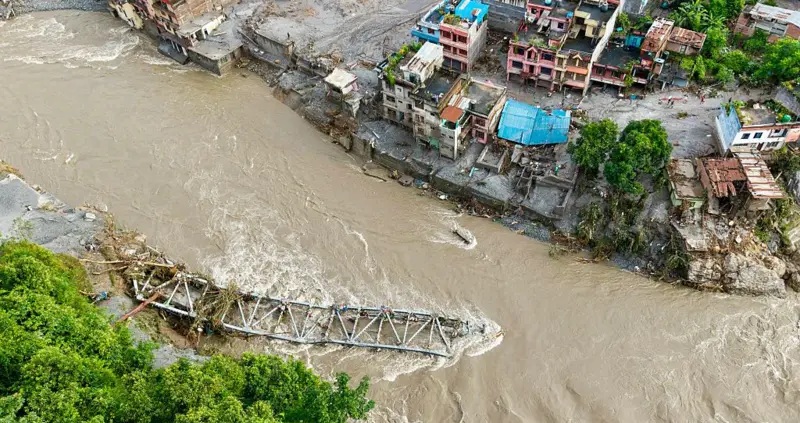

Kathmandu. The devastating floods in Bhotekoshi of Rasuwa district on Wednesday last week have caused a huge loss not only to the physical infrastructure of the country but also to the investment in the banking sector.
Especially in the flood-affected areas, the loans of billions of rupees issued by the banks to the general public by mortgaging their houses and land are now in danger of not being repaid. After the floods washed away the physical infrastructure and land as collateral, the investment of billions of rupees of the banks has become like water in the sand.



According to preliminary data from the banking sector, 11 commercial banks operating in flood-affected areas had disbursed personal and business loans worth Rs 2.42 billion. These loans were mainly taken by the general public to build their houses, buy land, buy cars, and run hotels, lodges and small businesses.
Not only did the floods destroy those structures, but in some places, the geography has changed, so now the bank has no basis to auction the mortgage or adopt other options to recover the loan. Due to the lack of collateral, 2028 loan accounts are now completely at risk.
This financial crisis is not limited to loans. The floods have also dealt a big blow to the direct cash and physical assets of the banking system. When the branches and extension counters of various banks were washed away by the floods, even the vaults of the banks which were supposed to be safe could not be saved. According to the information received, Rs 15.02 crore in the vaults of the bank and Rs 1.07 crore in the ATM machines of different places were washed away by the floods. Apart from this, the physical property of the bank including buildings, furniture, computers and other equipment worth Rs 55.16 crore has been destroyed.
Another reason why this aspect of the financial loss is even worse is the investment in the hydropower sector. The floods have completely or partially destroyed 13 hydropower projects (8 in operation and 5 under construction) in the flood-affected areas. Banks have invested billions of rupees in these projects through consortium loans. With the full details of the damage to the hydropower projects and the share of the banks still to be ascertained, the actual loss to the banking sector is set to go far above the Rs 2.42 billion that has now been made public.
Along with this, the banks are also facing another serious challenge. Deposits worth Rs 4.72 billion were collected from more than 75,000 people in the affected areas. On the one hand, the banks have the obligation to return the deposits of the people, and on the other hand, there is no way to recover the loans mobilized from the same deposits. This is going to cause a big blow to the financial balance of the banks.
Along with physical and financial losses, the banking sector is also facing a lot of human suffering. 27 employees of 11 banks serving remote areas are still out of contact. Due to the disappearance of employees and the destruction of branches, it is difficult to resume banking services immediately in these areas and to collect the final data of the damage.
In such an unprecedented crisis, it is not possible for the banks alone to manage this loss. In this unique situation where the customer has lost all his assets and the bank has also lost both the mortgage and the investment, the role of the regulatory body Nepal Rastra Bank is seen to be important.
If the NRB does not adopt a special relief package for borrowers and banks in such areas, loan rescheduling or provisioning (loss management), it will have a negative impact on the bad loan (NPL) rate of the entire banking system.