



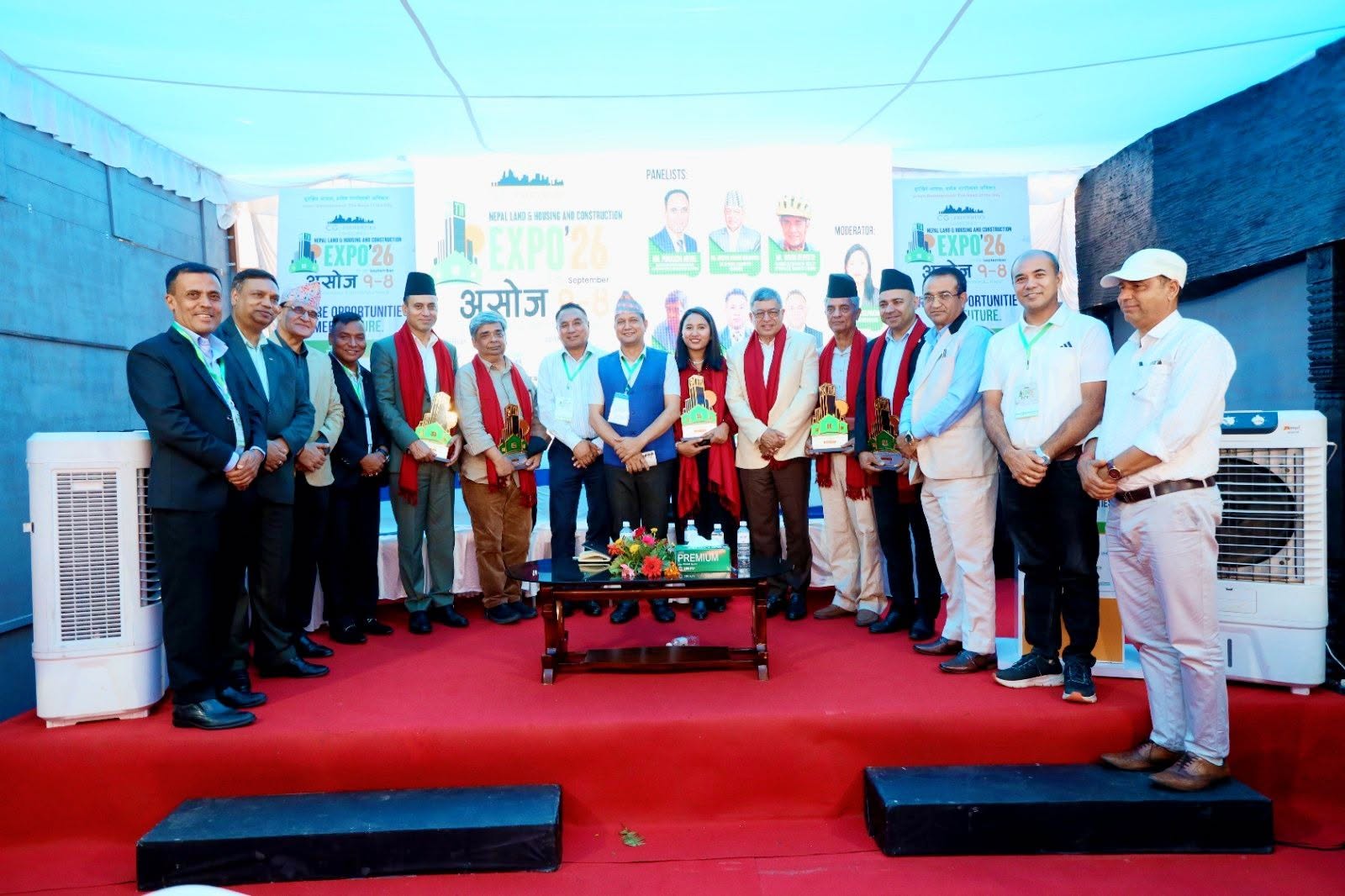

KATHMANDU: Stakeholders have stressed the need to advance integrated housing development through public-private partnership (PPP) for sustainable post-disaster rehabilitation and reconstruction. On the occasion of the 75th Diamond Year of Nepal Chamber of Commerce (NCC), Nepal Land and Housing Development Association and Nepal Land and Housing Development Federation of Nepal (NCC) and co-organized by Nepal Chamber of Commerce (NCC) on Saturday, the speakers said that disaster risk reduction should be linked with the housing and urban development plan.
During the discussion, Deputy Development Commissioner of the Kathmandu Valley Development Authority Prakash Aryal said that risk identification should be done before construction to minimize the loss of life and material due to disasters. He said that it is necessary to make the risk communication and preparedness system effective and to connect the building construction permit system with the overall process of construction.



He stressed the need for a comprehensive integrated policy to systematize the development of river corridors and settlements in vulnerable areas. He said that the damage caused by disasters could be reduced if the situation of vulnerable population and property could be linked with housing planning and investment.
Aryal said that although there are laws related to building construction and building code, there are still challenges in their effective implementation. Stating that the practice of electronic building permit system is going on at the local level, he pointed out the need to revise the building code according to the time keeping in mind the earthquake risk. He argued that integrated monitoring, early warning system and risk-sensitive planning should be integrated into the construction system to avoid natural disasters like Rasuwa floods.
Deepak Kumar Malhotra, senior vice-president of Nepal Chamber of Commerce, said that the housing and real estate sector needs a business-friendly policy. He said that effective collaboration between the two sides is necessary as the government formulates policies and the private sector takes forward investment and development accordingly.
He said that the issue of sale of apartments to foreigners and transfer of ownership of the area for collective use of joint and group housing in Nepal has not been fully systematized yet. He said that although some issues have been addressed through the budget, the necessary policies have not been fully implemented yet. He suggested that the government and the private sector should collaborate to build ‘affordable housing’ targeting the middle class and flood victims.
Malhotra said that about 240 industries and businesses are directly or indirectly linked to the real estate sector and the activities in this sector will have a positive impact on the construction materials to financial and service sectors. He stressed on the need to take forward housing development works in all seven provinces of Nepal through the public-private partnership model. “The tendency to look at all those who invest in real estate as real estate traders should change,” he said, adding that a positive environment should be created for investment in housing and infrastructure as the economy is run by investment. ’
Architect Nabin Devkota of the Society of Nepalese Architects (SONA) said that implementation and strategic weakness are the main problems in Nepal rather than the lack of policies and laws related to housing and land development. He said that there is a need for standard-based housing development in Nepal like in developed countries, and the conflict between different policies and regulations is creating problems.
He said that the building code has not been implemented uniformly across the country, monitoring is weak and wrong practices in engineering approvals should be controlled. Stressing the need to institutionalize the role of expertise in the building permit process, he said that the local level should not look at building construction only as a source of income.
Architect Biresh Shah, director of Kathmandu Institute, said that urban development should not be seen only from the perspective of a single subject. According to him, urban development requires coordination of various subjects including economy, community, culture, environment, geography, sociology and architecture.
He said that the planned urban development practice that started in Nepal about 60 years ago should be modified according to the time. He said that the tendency to consider only the construction of roads and physical infrastructure as the basis of urban development can lead to long-term problems. “The tendency to look at all those who invest in real estate as real estate traders should change,” he said, adding that a positive environment should be created for investment in the housing and infrastructure sector as the economy is run by investment. ’
Architect Biresh Shah, Director of Kathmandu Institute, said that urban development should not be seen only from the perspective of a single subject. According to him, urban development requires a combination of various subjects including economy, community, culture, environment, geography, sociology and architecture. He argued that the traditional knowledge adopted by our ancestors and the original styles of urban development should not be forgotten while planning a modern city.
He said that the planned urban development practice that started about 60 years ago in Nepal should be modified according to the time. He said that the tendency to consider only the construction of roads and physical infrastructure as the basis of urban development can lead to long-term problems. Shah said that the ancient architecture and urban planning of Nepal’s traditional and historical settlements should also be learned. Stating that foreign experts have also been attracted to study the practice of developing Nepalese cities and settlements about 800 years ago, he said that the original knowledge and technical aspects of heritage, art and structures should also be preserved during modern development.
Chairman of the program, Engineer Deepak Kunwar, President of Nepal Land and Housing Developers Association, said that the settlements and properties located on the banks of the river and other vulnerable areas should be re-evaluated. He said that the government should make a long-term plan for the development of safe housing in the vulnerable areas at a time when the risk of glacial lake explosion, flood and other natural disasters is increasing.
He said that safe and managed housing can be developed by using the government land which is some distance from the risky areas in a planned manner. He stressed on the need to move towards building safe and prosperous cities by learning lessons from disasters like floods in the Bhotekoshi area. He said that the private sector is ready to collaborate with the government in a non-profit manner for the construction of safe houses keeping in mind the risks of floods and landslides like Rasuwa-Trishuli and riverbanks.
On the occasion, Dr. Mandip Subedi of Nepal Geotechnical Society. Mandip Subedi said that scientific study of soil and geographical condition should be given priority in reconstruction and housing development. He said that the tendency to make policies and construction standards only after huge loss of life and property should be ended and focus on risk identification and mitigation before disaster strikes. He said that study on soil condition, geographical risk and capacity of structures should be made mandatory during reconstruction. He said that although we were successful in developing hard wire for infrastructure construction, we failed to develop integrated settlement as we could not integrate it in software.
The event was facilitated by Pramila Shilpakar, Architect from Khwop Engineering College and representatives from the private sector and experts related to housing, land development, construction, urban planning and disaster management.
The Nepal Land and Housing and Construction Exhibition-2026 being held at Bhrikutimandap from September 14 to September 19, has stalls of various companies and organizations related to housing, land, construction materials, technology and infrastructure.