



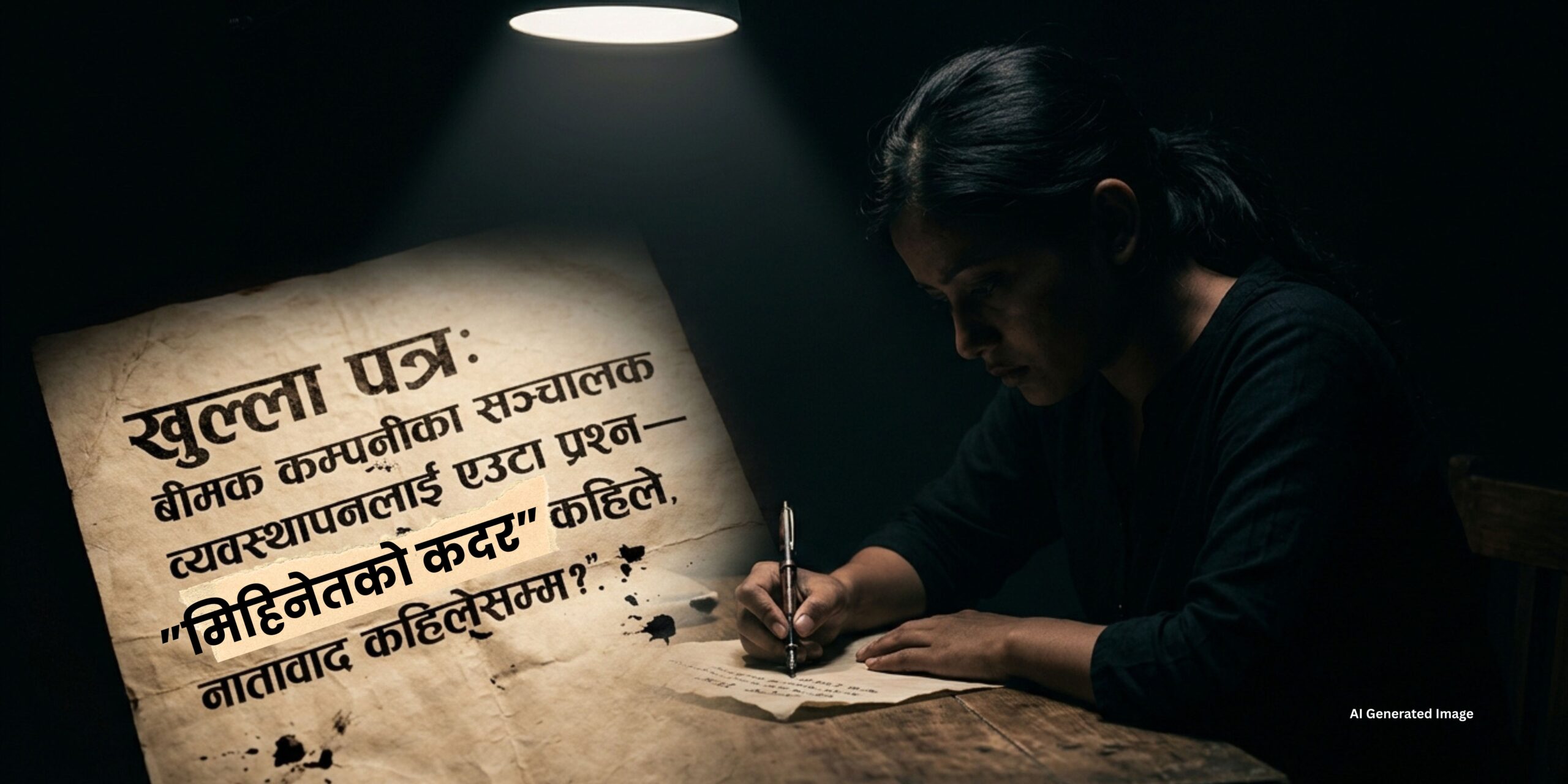

Mr. Chairman and Chief Executive Officer,



Life and Non-Life Insurance Companies of Nepal.
This letter is not the personal outrage of any one person. It is the muffled voice of hundreds of employees who work day and night in Nepal’s insurance sector, running without rain to fulfill their business goals, and who have spent years considering the company as their home.
Many people think that there is attraction in the insurance sector and there is good service. But from the outside, it is only after entering this field that it is attractive. Here, the value of nepotism and nepotism is much more than hard work and performance.
Today, many of us are not able to speak openly. The reason is clear: the fear of losing a job or facing mental stress for protesting against discrimination. But someone has to speak this truth.
1. On the one hand, to get the opportunity and appreciation on the other{
}
Insurance companies have employees who work daily from branches in the valley to branches in remote districts. Those who put their personal lives at stake to improve the balance sheet of the company. But when it comes to evaluation, those honest and dedicated employees are always overlooked.
On the other hand, people close to management, bosses’ favorites and people with access always come forward no matter how much failure or negligence they show in their work. They are the ones who are given new opportunities, flexible environment and high valuations. Is being qualified in the insurance sector the biggest curse?
2. Double standards in leave and convenience{
An ordinary employee has to give many explanations when he asks for leave due to household or health problems. It is difficult to get leave even after planning months in advance. However, the management people are provided with weeks of leave and flexible time without any hassle. Why two rules within the same organization?
What do you do when you ask for a promotion or ask for an increase in benefits? This is the question. But when you need leave for some important work, then the same CEO or the head of the human resources department asks who else will do such work while you are on leave? Who else can do the work you are doing? This question is raised and Ayesh gives the statement that you should not take leave.
3. Opacity in promotions and career development{
The employees who have been working sincerely in the company for 4-5 years and are successfully fulfilling the responsibilities given to them are still there. However, the people who have just arrived or who know how to maintain good relations with the higher level (flattery, flattery, spy against their colleagues) are being promoted every two years.
If the criteria of promotion are transparent, then it should be made public clearly for all. On what basis, on what goals is being achieved or by evaluating the ability to be promoted? If the answer is only the personal whims of the bosses, then it is killing the morale and integrity of honest employees. For the sake of transparency, every insurer should have in its HR dashboard the employees of all levels who have been promoted for what reason and how many marks? What are the criteria for getting such marks should be brought to the notice of everyone in a transparent manner, only then it will be possible to refute the serious allegations against the top management.
4. The illusion of the slogan that we are one family
At company meetings, trainings, special events, or meetings, the leadership class (chairman of the board of directors or the CEO) always hears the same speech, “We are all one family.” ’
But is there such a huge disparity between their children in a real family? Does one family favor some members and sideline some? What kind of culture is this that insurance companies seek 100 percent dedication from employees but cannot provide a fair environment in return?
A polite request to the leadership category
}
While the Insurance Authority of Nepal is talking big about corporate governance, the internal governance and human resource situation within the company is deteriorating. In the name of cutting expenses, the salary of the employees has been taken away from the past through salary restructuring and post restructuring. The Insurance Authority has also helped in this by approving the Human Resources Regulations submitted by the insurer.
In recent times, there are no quality training opportunities for the employees. The Chief Executive Officer, the Board of Directors, the heads of the marketing department are misusing the staff training expenses by participating in foreign trips and trainings. Career development opportunities have been snatched away.
We do not want to leave the company. We want to take the organization to greater heights. But when a hardworking person realizes that his sweat has no value, then the future of the organization cannot be long-term.
Let the chief executive and the board of directors of the company sit and watch for some time not only in the management chair but also in the chair of an ordinary employee. Let them feel the frustration where years of contribution are ignored simply because they do not know how to flatter.
We don’t need any special privileges. All we need is fairness, transparency, and justice.
Hopefully, this letter will not be seen as just a complaint, but as a wake-up call for reforms in the insurance sector.
- An employee working within the insurance sector but frustrated and neglected.