




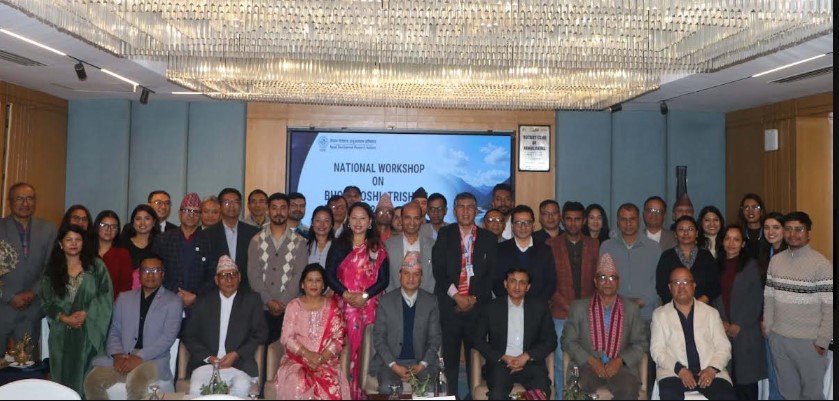

Kathmandu. Dr. Gunakar Bhatt, Vice Chairman of the National Planning Commission, Gunakar Bhatt stated that risk reduction and sustainable development caused by climate change should be placed at the center of the national development plan. He mentioned that the disaster in the Bhotekoshi–Trishuli region clearly highlighted the interrelationship between climate change and development, and emphasized that special attention should be given to secure and decentralized development, risk-resilient infrastructure, and long-term reconstruction.
Dr. Bhatt expressed this view while inaugurating the national workshop titled ‘Bhotekoshi–Trishuli Disaster 2083: From Serial Disaster Risk to Resilience’ organized by the Nepal Development Research Foundation (NWI) on Wednesday at the Square Hotel in Jhamsikhel, Lalitpur. Bhatt expressed this view.



He stated that the Bhotekoshi–Trishuli disaster indicated that Nepal’s climate and environmental risks were becoming more serious than expected. He noted that according to the initial damage and post-disaster needs assessment (PDNA), significant financial resources are required for the rehabilitation and reconstruction of the affected areas, and he emphasized the need to develop development plans that consider the effective deployment of available resources and risks.
Dr. Bhatt emphasized that the impacts of climate change cannot be viewed in isolation from the development process, emphasizing the need to advance risk management, safe and decentralized development, the development of alternative rehabilitation centers, and the construction of risk-resilient infrastructure in an integrated manner. According to him, post-disaster reconstruction should not be limited to the process of compensating for immediate damage but must lay the foundation for long-term development that also mitigates potential risks in the future.
He also expressed confidence that the conclusions and recommendations from the workshop would make a significant contribution to the development of upcoming reconstruction plans, sectoral reports, and the vision for Nepal’s long-term development.
In the opening session of the workshop, Dr. Shikha Thapa Magar, Executive Director of Navyap, delivered the welcome address, stating that the Bhotekoshi–Trishuli disaster highlighted the interrelationship between climate change, landslides, debridge flows, changes in river flow, and infrastructure damage in Nepal’s mountainous regions. She explained that the main objective of the workshop is to analyze the multidimensional risks caused by and from disasters, and to prepare evidence-based policy and actionable suggestions for risk reduction, resilient reconstruction, and disaster-resilient development.
The program’s chief speaker, Dr. Ravindra Prasad Vasti, a leading water resources expert at the Asian Development Bank (ADB), Manila, Philippines, Ravindra Prasad Vasti, stated that the risk of multidimensional and serial disasters is increasing due to climate change in the Himalayan region. He explained the Bhotekoshi–Trishuli disaster as a complex disaster arising from the interconnection of climate change, Himalayan geological processes, river systems, and human intervention.
He emphasized that such disasters should not be attributed solely to heavy rainfall or any single cause, emphasizing the need for a comprehensive analysis of the Himalayan geological structure, rock and gegran flows, riverine processes, and risky development practices. He emphasized that scientific research, advanced monitoring and early warning systems, climate-resilient infrastructure, and regional cooperation should form the foundation for long-term risk reduction.
Special guest Yubaraj Bhusal, former Secretary of the Government of Nepal and former Executive Chief of the National Reconstruction Authority, said that the early warning system should not be limited to just information flow but should be linked to community preparedness, awareness, and response capacity. He informed that the Post-Disaster Recovery and Reconstruction Plan (PDRP) is being prepared to organize the recovery and reconstruction process after the Bhotekoshi–Trishuli disaster, stating that cooperation among the government, development partners, the private sector, and the expert community is essential for its effective implementation.
In the technical session, Dr. Divas Bahadur Basnyat, Head of the Water and Climate Program at Navyapra, presented on ‘Climate Change, Serial Multi-Disaster Risk and Its Impact Analysis in the Mountainous Region.’ He analyzed that the Bhotekoshi–Trishuli disaster is not a normal flood but a series of disasters that began as an avalanche mixed with rock and ice, then flowed through the Debridge flow and then turned into a river flood.
Similarly, Professor Dr. Punyaprasad Regmi emphasized the need for long-term resilient development through the construction of safe settlements, sustainable agricultural systems, and disaster-resilient infrastructure. He stated that at-risk settlements should be classified based on scientific assessment for safe rehabilitation, and reconstruction should not be limited to housing construction but should be linked to livelihoods, agriculture, employment, and social services.
The workshop also included discussions on the nature and management of debridge flows, climate change and its impacts, and regenerative development. Prof. Dr. Tara Nidhi Bhattarai, Dr. Divas Bahadur Basnyat, and Prof. Dr. Punyaprasad Regmi facilitated these group discussions, respectively.
Suggestions emerged from the discussions to strengthen the research and monitoring system related to debridge flows, to conduct integrated studies of risks related to climate change and the cryosphere, to build the capacities of existing institutions, and to build effective institutional mechanisms for post-disaster recovery and reconstruction.
The workshop concluded that since glacial systems are inland in nature, cooperation and coordination between Nepal, China, and India need to be increased, long-term and site-specific data systems on climate change must be developed, and coordinated policies among the federal, provincial, and local levels are necessary for the environmentally friendly use of sand, gravel, and other sediments deposited by rivers.
Similarly, participants emphasized the need to make the safe resettlement of affected families, management of at-risk settlements, active involvement of local government, and protection of the community’s socio-cultural aspects integral to reconstruction.
Concluding the program, Dr. Navaraj Khatiwada, a founding member of Navy and a senior research expert, emphasized the need for systemic thinking, effective governance, and long-term planning for disaster risk reduction. He emphasized that geographical and disaster risks must be prioritized in development planning, infrastructure construction, land acquisition, and natural resource utilization.
Since its establishment as a non-profit organization in B.S. Since its establishment in 2060 B.S., it has been conducting studies and research for evidence-based policymaking. The institute has been conducting research in disaster risk reduction, climate change, water resource management, livelihoods, environmental sustainability, and public policy.