




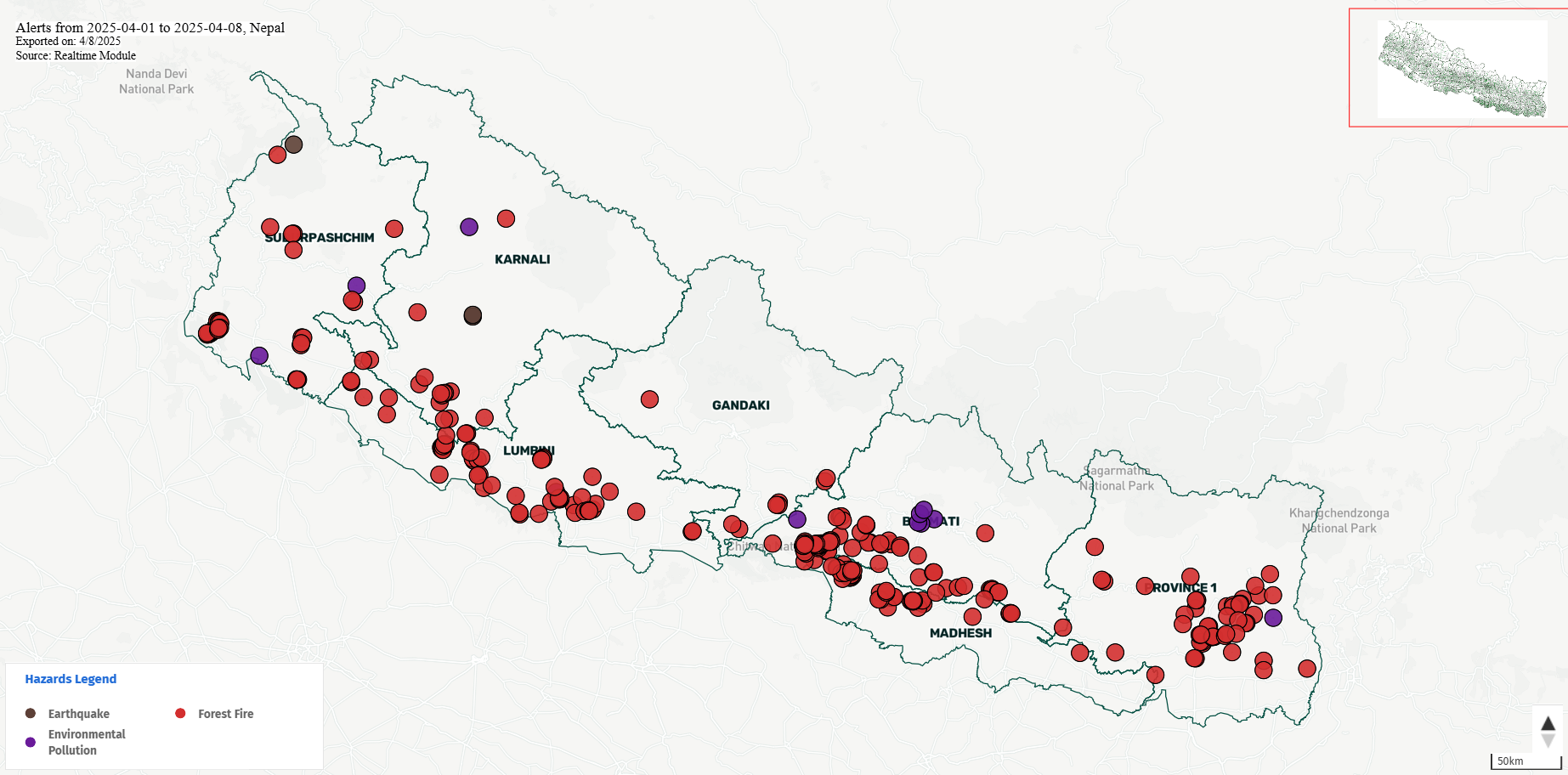


Kathmandu. Due to continuous forest fires, dry weather and stable atmospheric conditions, polluted air is now covering the settlements outside the Kathmandu Valley.
According to the information posted on the government’s disaster portal on Tuesday, the air pollution measurement from Panchthar in the east to Achham in the far west has exceeded AQI 150. The sky over Panchthar, Dang, Bharatpur, Dhangadhi, Achham, Bhaktapur and Lalitpur is shrouded in haze. The pollution has spread to the atmosphere due to forest fires in nearby places outside Kathmandu.


On Monday alone, the government’s disaster portal recorded more than 200 forest fire incidents and 258 fire incidents across the country. Of the three deaths, one was due to the fire itself and the other two were due to incidents related to the forest fire, according to records.
Apart from its own air pollution, smoke from the fires has also been lingering in the Kathmandu Valley, adding to its pollution problems. In Kathmandu’s Shankha Park, the AQI reached 213 on Monday – a level considered “very unhealthy”. Bhaktapur and Ratna Park followed closely with AQIs of over 190.
According to the International Centre for Integrated Mountain Development (ICIMOD), the valley has suffered from polluted air for 75 of the past 90 days. The main reasons for this are forest fires, vehicle emissions, road dust, construction activities, and unstable weather conditions.
Flights have been delayed or diverted due to reduced visibility across the country, including at Tribhuvan International Airport, due to the inability of aircraft to land due to bad weather.
Protests by political parties, teachers’ organizations, and cooperatives and microfinance victims have increased the crowd on the streets of Kathmandu city. Traffic management in the valley, disrupted by the exhibition, has worsened the situation with traffic jams, leaving the general public exposed to outdoor air pollution for long periods.
The Department of Hydrology and Meteorology has forecast brief showers or thunderstorms in the hilly areas of Bagmati, Gandaki and Lumbini provinces, which could provide temporary relief by reducing haze. While brief showers are forecast in some parts of Bagmati, Gandaki and Lumbini, meteorologists have warned that this may not be enough. A brief shower is unlikely to reduce dust or significantly remove haze.
The Ministry of Health has urged the general public to stay indoors, wear masks and avoid highly polluted areas. As pressure mounts, calls are growing for the government to declare a health emergency in Kathmandu.