




Kathmandu. You have a small dust on your hands, that’s just a gram. If it explodes, the energy released will produce an explosion equivalent to four Hiroshima-sized atomic bombs. And its price? About $62.5 trillion per gram.
It’s called antimatter



Our entire universe is made up of ordinary matter. Man, air, water, stone, sun, everything. Antimatter is the exact opposite of matter. The normal electron has a negative (−) charge; The anti-electron (positron) has a positive (+) charge. The normal proton has a positive (+) charge; The anti-proton has a negative (−). When these two meet, 100% of the mass is converted into pure energy. No ash, no smoke, just intense light and heating.
How much antimatter has been produced so far?
From 1995 to 2025, all experiments around the world combined to produce about 10 nanograms (0.0000000001 grams) of antimatter. So many would not turn on the lamp even for a second. Still, billions of rupees have been spent on its production.
Where is it produced?
- CERN (Switzerland–France border): The world’s largest machine LHC (27 km long circular tunnel).
- Fermilab in the US.
- The GSI Helmholtz Center in Germany.
In these places, the particles accelerate at 99.999% of the speed of light and collide with each other. Collisions create antimatter particles for brief moments.
How is it placed?
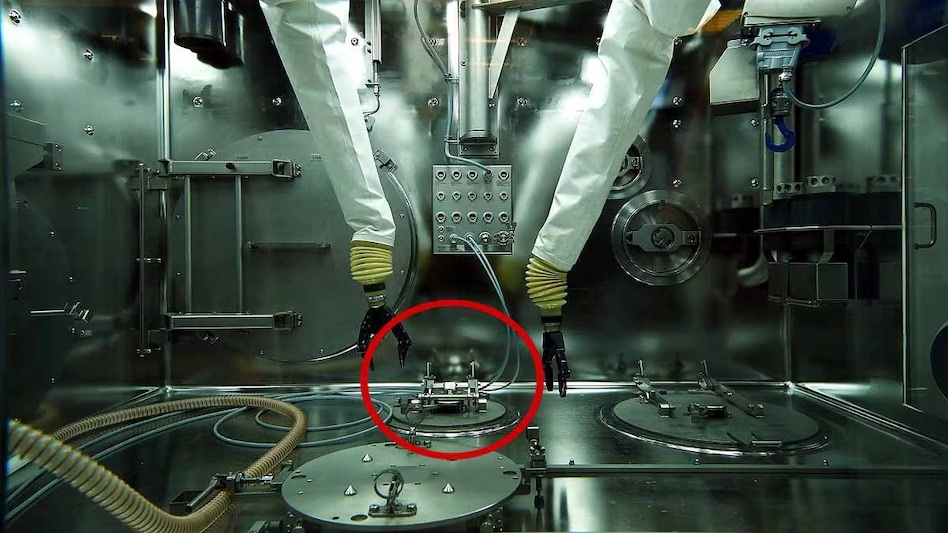
Antimatter cannot be allowed to touch anything. Otherwise it will explode immediately. That’s why it’s kept extremely cold. approx. −273 °C (near absolute zero).
It floats in the air using powerful magnetic and electric fields (penning traps). It is checked millions of times per second to ensure that no particles hit the walls.
In 2011, CERN set a world record for surviving 309 anti-hydrogen atoms in 16 minutes and 40 seconds.
What could happen in the future?
Today, it takes 7-9 months to travel to Mars. Antimitor rockets can reach Mars in just 1 month and other stars in a few years. NASA calculates that just 10 milligrams of antimatter can power an entire spacecraft on Pluto.
Renewable source of energy: 1 gram of antimatter + 1 gram of normal matter = 43 kilotons of energy equivalent to TNT. This means that just 1 gram can give power to an entire country for 10-12 days.
Cancer treatment: PET scans already use small amounts of positrons (anti-electrons). In the future, anti-protons could be used to target cancer cells more precisely.
Why is it so expensive?
To produce 1 gram, the LHC would have to run continuously for 1 million years. Millions of rupees are spent on every second of use. So far, billions of dollars have been spent on production. Today antimatter is simply a laboratory property. But tomorrow, it can transform human civilization. The day we can produce and store it cheaply and safely, energy will be truly free. Then, not just gold or diamonds, but dazzling antimatter floating in a tiny bottle, will be the world’s most precious treasure.