



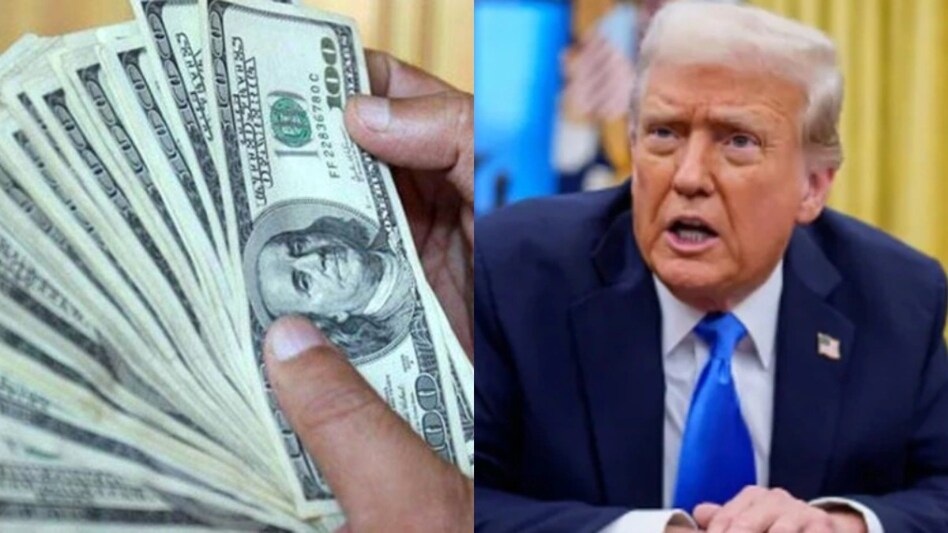


Kathmandu. Former US President Donald Trump has recently taken an aggressive stand to protect the global supremacy of the dollar. The biggest reason for this is that many countries of the world are trying to reduce their dependence on the US dollar.
Trump warned BRICS countries (Brazil, Russia, India, China, South Africa) and their new allies that if they tried to introduce alternative currencies instead of the dollar, the US could impose tariffs ranging from 10 percent to 100 percent and exclude such countries from the US market.


Trump’s emphasis on the dollar is reflected in his statement. “The dollar is the king of the world and we will keep it that way,” he told a cabinet meeting on Tuesday. ’
Trump is taking this aggressive stance as the global position of the dollar appears to be weakening. In the early months of 2025, the value of the dollar fell the most since 1973. Trump’s tax and protectionist policies have also raised questions about global trade and the stability of the dollar.
On Tuesday, Trump spoke about putting the dollar at the forefront of his aggressive trade policy. “Losing the dollar standard would be like losing a war, a big world war,” he said. In such a situation, we will no longer be a country like before and we will not allow this to happen. ’
Brazil, Russia, India, China, South Africa: These countries are trying to bring in a new common currency to replace the dollar. Which is seen as a ‘BRICS unit’ or digital currency. Trump has reacted strongly to this. Trump today imposed a 50 per cent tariff on Brazil, an important member of BRICS. In addition, he warned the rest of the countries.
New members: Indonesia, Malaysia, Thailand, Algeria, Belarus, Kazakhstan, Nigeria, Turkey, Uzbekistan etc. are also joining BRICS and moving towards de-dollarisation.
However, nothing is yet clear about the new BRICS currency. India is moving cautiously on this issue. Because It is difficult for India to believe in the policy of China, the largest country of BRICS.
Brics Plus (Brazil, Russia, India, China, South Africa and new members) countries are now playing a big role in the global economy. In 2023, the share of BRICS+ countries in global GDP reached about 28 per cent and global trade to 23-26 per cent. These countries represent 63 percent of the Global South’s GDP. If these countries leave the dollar, it could have a big impact on the US currency.
Led by Russia, countries like Armenia, Azerbaijan, Belarus, Kazakhstan, Kyrgyzstan, Moldova, Tajikistan, Turkmenistan, Uzbekistan, Ukraine, etc. have decided to use the dollar as little as possible as payments in the future. These countries are now using their local currency or other options in mutual trade.
China has promoted its yuan in international trade and, along with Russia, has increased trade in local currency instead of the dollar. Both countries have also developed their own digital currency platforms. Russia is increasing its yuan trade with Brazil and Saudi Arabia.
Meanwhile, Russia has emphasized trade in rubles and yuan and is developing a system different from Swift.
India has started trading with Russia and other countries in rupees. However, 86 per cent of India’s trade is still in dollars. African countries have also started developing payment systems in local currency instead of dollars. So that trade can be cheap and free.
Countries like Russia, Iran and North Korea are looking for new alternatives to the dollar due to US sanctions. Many countries want to protect their economies from U.S. policy and dollar volatility. That’s why they are seeking economic sovereignty. So that they do not depend on America.
To challenge the global supremacy of the dollar, BRICS, CIS, Africa and many other countries are jointly adopting new currencies, digital platforms and local trading systems. Realizing this danger, Trump’s aggressive stance has come to the fore.
Experts believe that the supremacy of the dollar will not end completely yet. However, its grip is definitely weakening. – Agency