



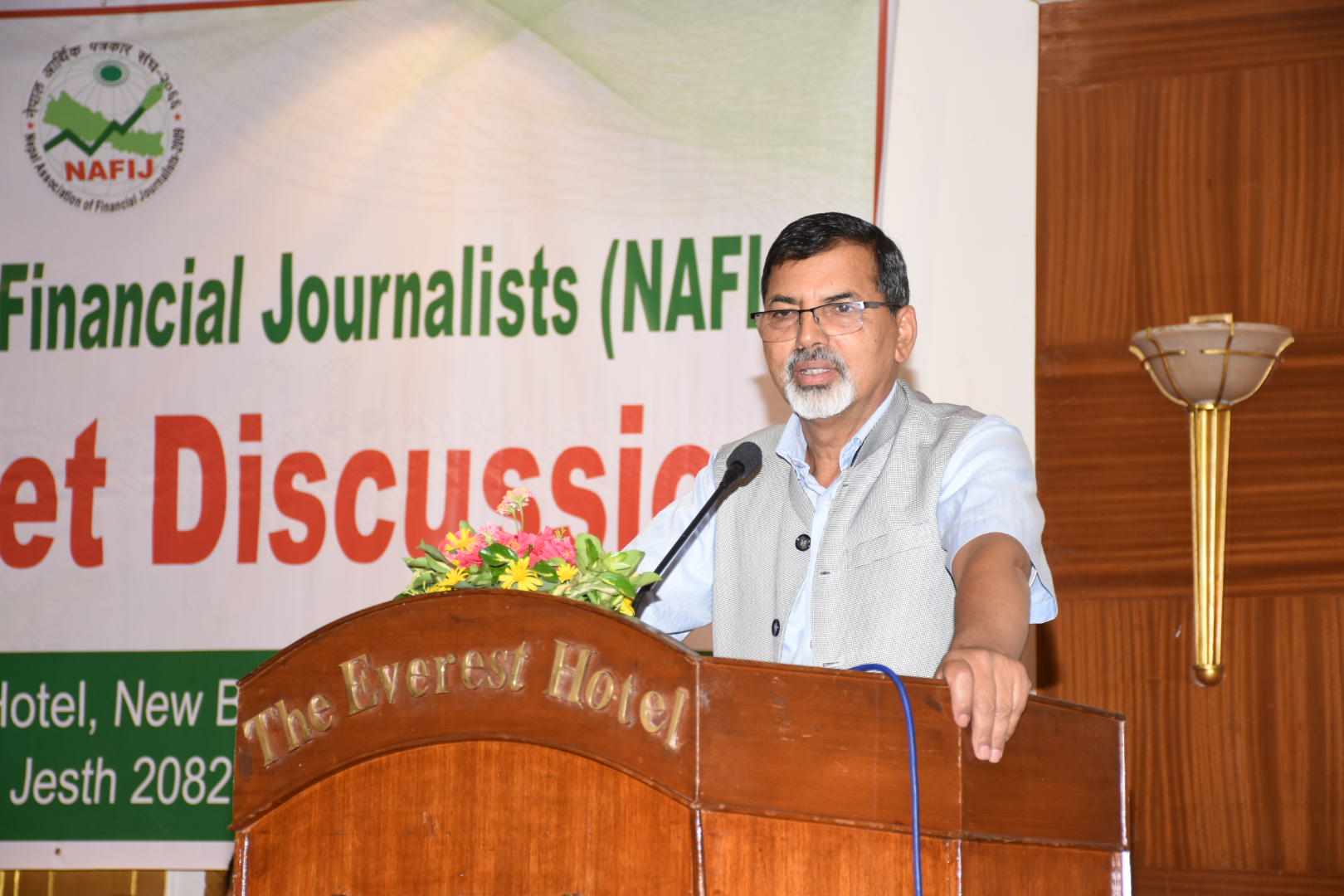


Kathmandu. Former Finance Minister Janardan Sharma has said that the private sector is a big body in the economic sector and it is positive to be encouraged by the budget.
Speaking at a post-budget discussion programme organised by the Association of Economic Journalists of Nepal (NAFIJ) here on Saturday, he said although some policy aspects of the budget were good, criticism was needed in essence. Some suggestions and criticisms are natural, he said. He said that although the structure, expansion of the economy, etc. are a continuation of the past, the positive things cannot be denied.


Sharma said that the government should also pay attention to the economic growth rate and the impact on the lives of the people. He said the government needs to focus on achieving its goals.
Sharma pointed out that the government needs to pay attention to change the country and balance when imports are 10 times more than exports. Stating that the iron industry in Nepal has increased to 37, he said there was a need to pay attention to how much raw material came for these projects and how much raw material was opened for these projects and the processing was opened by opening the company.
Sharma, a former finance minister, said new things have taken place but they have not been able to do as much as they should have. “What this budget has done is important for the private sector to engage in manufacturing. Resources and linking with farmers have not been seen anywhere in this budget,” he said, adding, “Nepal’s current economic system needs to be restructured.” This is very important. I may wonder why I didn’t, but now the powerful finance minister, made up of two big parties, should have done it. I was that kind of finance minister. ’
Sharma said that the budget is realistic. “Rs 12.17 billion has been spent so far in the current fiscal year and in the coming days, rs 2.5 trillion will be spent,” he said. On this basis, there is no qualitative basis for spending the budget for the next fiscal year. It will increase from Rs 1.5 trillion to Rs 1.6 trillion in the next fiscal year, but it will not yield results unless there is quality expenditure. ’
Sharma, a former finance minister, said businessmen and bankers were not left out. He said that while speaking on this issue, it is said that the private sector has come against it. He suggested that the government should pay attention to this as there is no condition to take loan from the bank.
Sharma said that only Rs 91 billion has been spent on development while normal expenses are difficult to meet. He said that the economic growth rate was slightly higher when the load shedding was ended, but it could not be done after that. “Investing 3 per cent will lead to 1 per cent growth rate. In this way, if you invest 18 percent, you will get 6 percent growth. Can the target of economic growth be achieved by increasing this?” he asked.
Sharma said he was confident that the monetary policy would also address something. “There is an additional budget of Rs 400 billion when Rs 1.6 trillion has not been spent. It will increase the economic growth rate 4. It’s 4 per cent,” he said.
Sharma said there was a need to pay attention to the areas of labour mobilization and youth mobilization. “Although there should be a program to represent the farmers in this budget, it has not been done,” he said. An industrial policy related to farmers is necessary. We also need to focus on marketing. ’
Sharma said agriculture was the main sector for Nepal’s development, followed by tourism and hydropower. “The country cannot move forward by selling electricity and people, so it should be reduced,” he said.