







Kathmandu. Nepal Insurance Authority (NEA) fiscal year 2081. Based on the approved actuarial evaluation report of 82, the details of the solvency ratio of the life insurer have been made public.
NeA has made public the schedule of solvency ratio determined on the basis of the actuarial assessment of life insurers for the last financial year through a monthly special issue called Insurance Reflection. NeA has made public the solvency ratio of the remaining insurers except the National Life Insurance Company, which was approved for the insurance assessment by mid-July of the last fiscal year. The list includes names of 16 life insurers, including 13 life insurers and 3 miniature life insurers.


According to nea data, the average solvency ratio of 13 life insurers is 2.17 percent. Reliable Nepal Life has the highest solvency ratio of 3.61 among life insurers. The authority has maintained a solvency ratio of 1.3 for life insurers, which is more than double.
The solvency ratio is 3.41 for Citizen Life and 2.70 for MetLife.
Similarly, National Life has the lowest solvency ratio of 1.34. This is close to the minimum limit set by the AUTHORITY. In the recent past, National Life has increased its investment in office buildings and large building infrastructure even for commercial purposes.
The ratio of all the three small life insurers is above the prescribed ratio of 1.5 for the small life insurer. Liberty Micro Life has a ratio of 2.0, Guardian and Crest Micro Life has a ratio of 1.97.
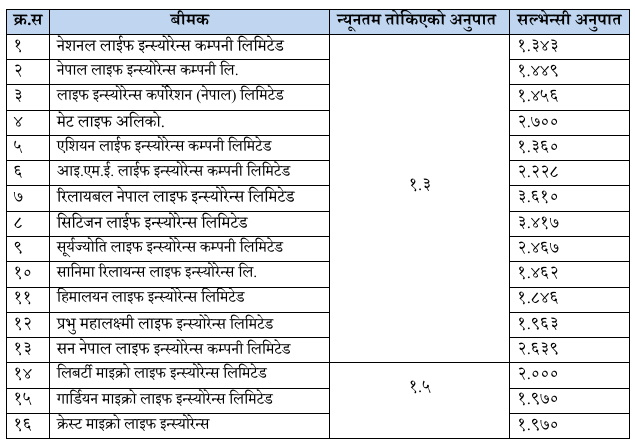
According to the NRA, all life insurers (including micro) have been found capable of meeting potential financial obligations based on the insurance assessment for the last fiscal year.
Fixing the solvency ratio at 1.3 by the NEA means that the insurer has at least Rs 1.30 of financial assets available to repay the liability of Re 1.
Solvency for a life insurer refers to its ability to repay its long-term obligations, especially liabilities on the insured, from its own assets. It is an important financial measure used to evaluate a company’s financial health and the strength of its assets. The high ratio indicates a strong financial position and a strong ability to bear unexpected losses and meet future obligations.