



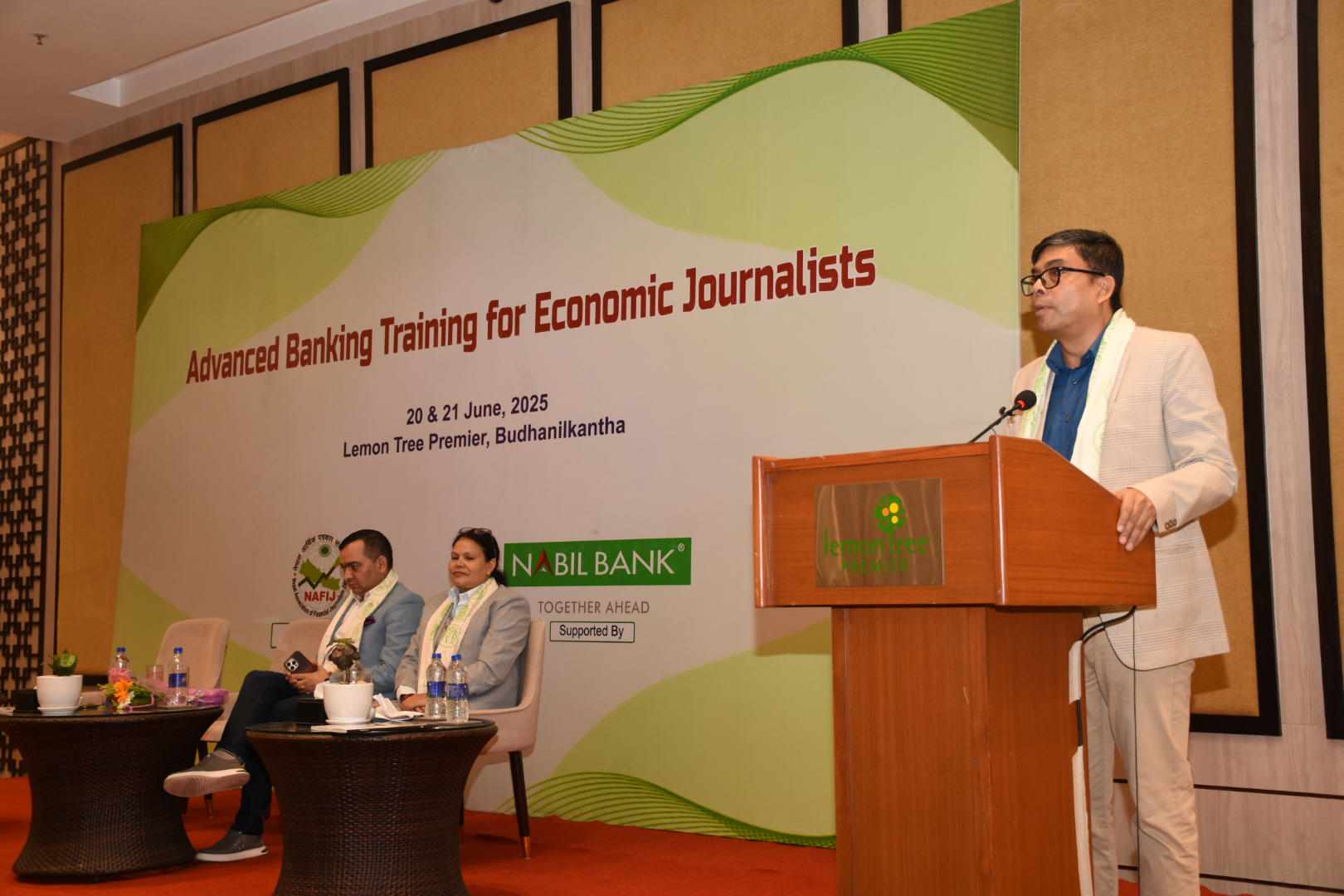


Kathmandu. National Planning Commission (NPC) member Prakash Kumar Shrestha has said that a real sector expansion-friendly monetary policy should be brought in. Speaking at the inauguration ceremony of the two-day ‘Advanced Banking Training for Economic Journalists’ programme organized by Nepal Economic Journalists’ Association in Collaboration with Nabil Bank in Kathmandu on Friday, Dr Shrestha said that real sector expansion is essential for economic prosperity. The program will continue till Saturday.
He said that the impact of economic slowdown is on the banking sector. “Due to the failure to expand the real sector, its impact is also visible in the banks. For this, the real sector needs to be expanded further,” he said.


He said that the upcoming monetary policy should be brought to increase the demand for credit. “Banks still have rs 700 billion worth of loanable money. In such a situation, we have to bring an upcoming monetary policy to increase the demand for credit,” he said. He said the demand for credit would automatically increase if the industry could be revived.
Nepal Rastra Bank (NRB) is preparing its monetary policy for the upcoming fiscal year. Dr. Shrestha said that the monetary policy should come in such a way that it would facilitate the enterprise sector to use credit.
“Nabil Bank is currently operating entrepreneur loans. If other banks give priority to such loans, it will have a positive impact on the entire economy,” he said.
He said the demand for internal loans has not increased as the government has not spent enough. Stating that the government’s spending cycle has been disrupted, he said the government should improve the financial expenditure and increase the internal debt.
Similarly, he said that the capacity of economic journalists is increasing. “Earlier, economic issues would not get priority in newspapers. At present, economic news can be seen widely in the media,” he said, adding, “At the same time, the capacity of economic journalists is also increasing.” Earlier, there were few journalists who understood financial issues. Now journalists are becoming competent in this regard. ’