



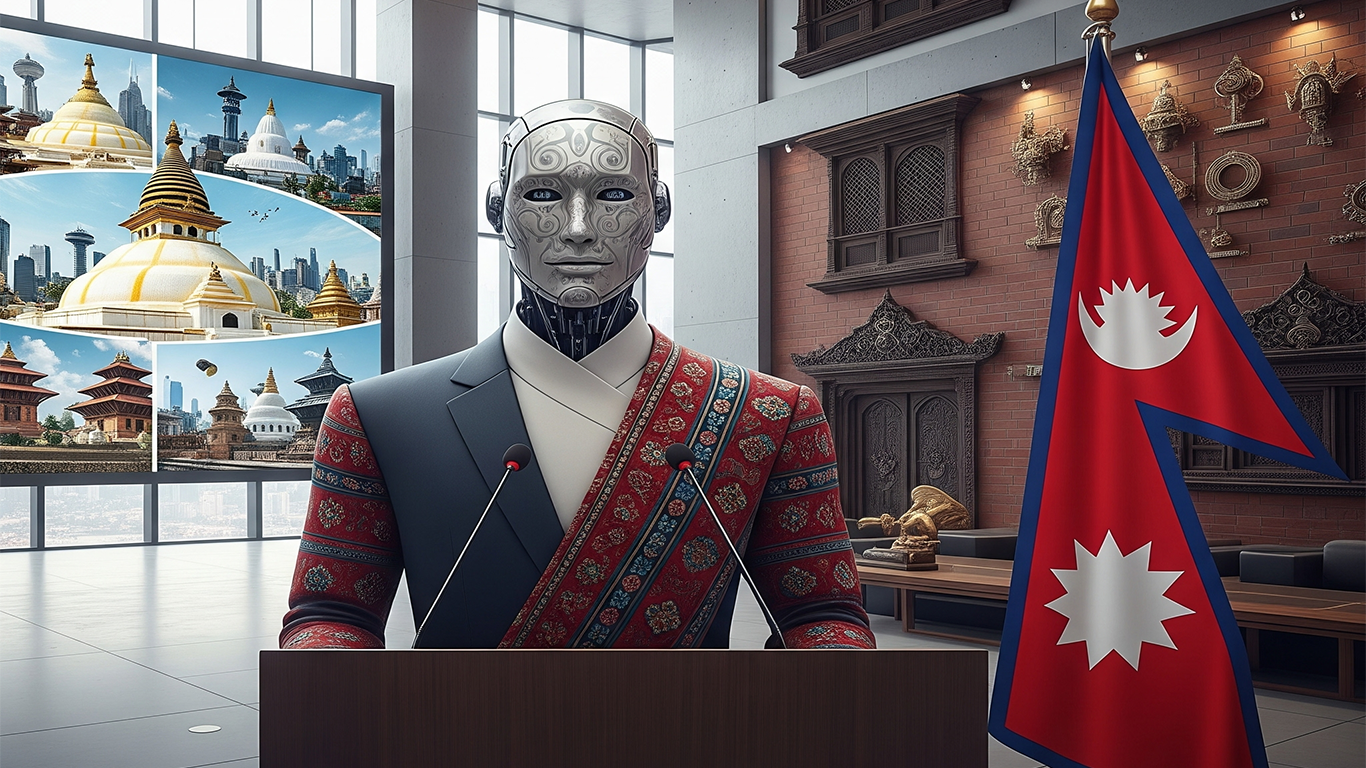


Kathmandu. Have you ever thought that your leader is not a human being but a computer program? A program that makes decisions based on facts without any bias? If so, Albania has surprised the world by turning that possibility into reality. But how can such technology work in a country with a complex political system like Nepal? Can it curb corruption, or will it just be another tool in political maneuvering?
AI Minister: Global Experimentation and Different Perspectives


}
There are different experiments around the world regarding the use of artificial intelligence (AI) in government governance. Albania set a new world record in September 2025 by granting the status of a government ‘minister’ to an AI-powered digital assistant called ‘Diala’. Diela’s main responsibilities are to oversee the public procurement process and control corruption. While the move is symbolic, it paves the way for AI to become an integral part of the government.
Italy, meanwhile, has focused on the legal and ethical aspects of AI, not as a minister. Italy became the first country in the European Union (EU) to pass comprehensive legislation on the use of AI at the national level. It has put in place strict regulations to control the misuse of AI and its safe use. While Albania has made symbolic use of AI by designating it as a “minister”, Italy has focused on its regulation and legislation.
In addition, countries such as the UAE and Canada have appointed humans as AI ministers to underscore the strategic importance of AI. These different models illustrate how countries around the world are integrating AI into their governments according to their political systems and needs.
Reference: Probability and Complexity{
}
Nepal’s politics is full of coalition governments, complex dynamics within the party, and frequent leadership changes. This has delayed any digital reforms or policy changes. In such an environment, the use of AI brings both possibilities and challenges at the same time.
Can TAG_OPEN_strong_27 AI Control Corruption?
Corruption and protectionism rooted in bureaucracy have been a long-standing problem in Nepal. An AI system can easily detect irregularities in government contracts, grant distribution, and service delivery. But will AI be able to stop the decisions that are caught in the web of politicians’ selfishness? For example, would an AI minister dare to ‘reject’ a contract file awarded to a leader’s ‘related’ company, the way a human minister wouldn’t?
Moreover, a robust digital infrastructure, digital literacy, and lack of legal frameworks required for the use of AI are major challenges in Nepal. The digital literacy rate in Nepal is only around 31 percent, which is not enough to bring AI to the citizen level. Unless people have faith in technology and the know-how to use it, AI will be seen only as an expensive tool and not as an adjunct to good governance.
Conclusion: The Hope of Technology, the Reality of Politics
The experience of Albania and Italy has given the message that AI should not only be seen as a technological revolution but also to understand its social, legal and moral implications more deeply. While the benefits of using AI in the context of Nepal seem attractive, implementing it requires transcending institutional stagnation and political divisions. Unless policymakers and the public have digital literacy and trust in technology, AI will be seen only as a technological tool and not as an adjunct to good governance. Will Nepal’s political leadership be able to accept this challenge of the future?