



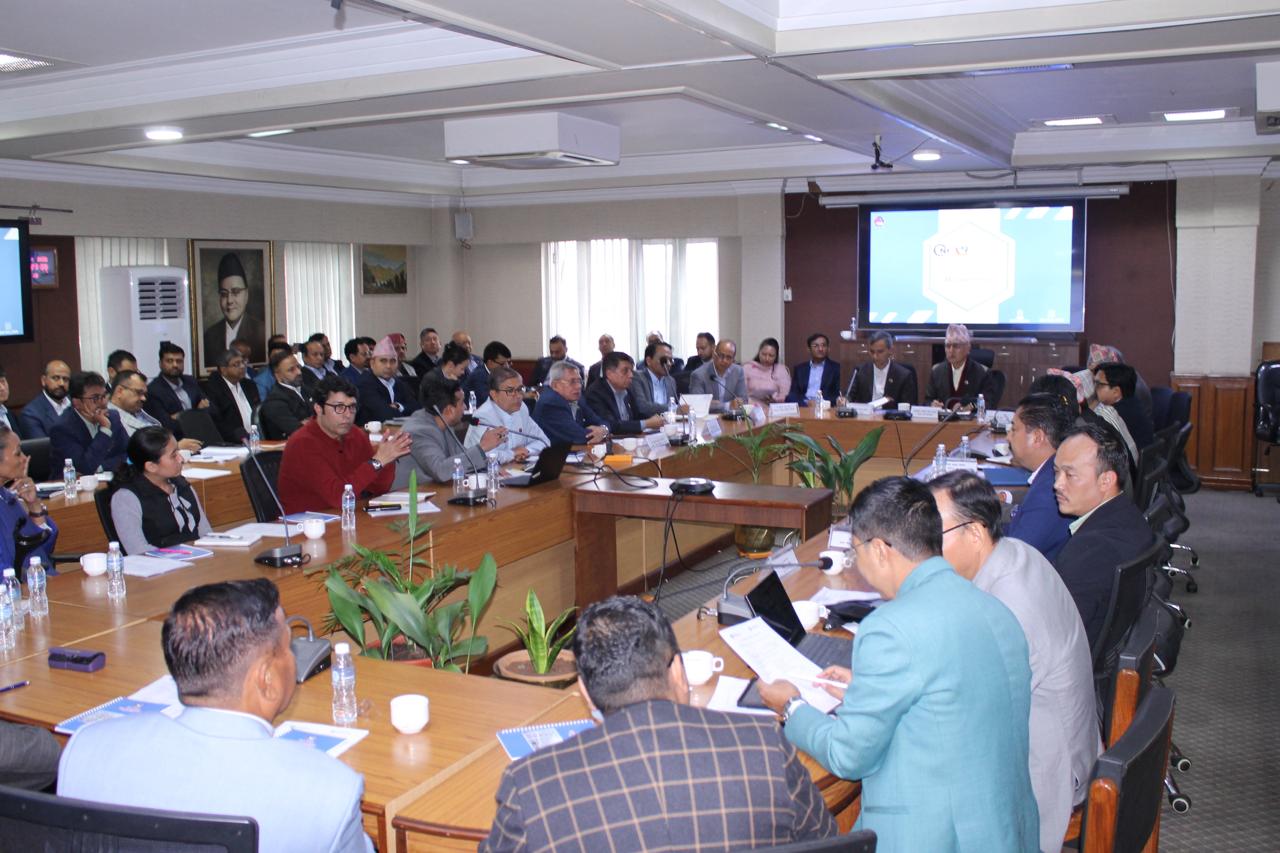


Kathmandu. The public-private dialogue has been organized on September 23 and 24 regarding the impact of the Genji agitation and the impact of the loss of life and property in the private sector, the experiences of the investors and the initiatives to move forward from the current situation. The event was jointly organized by the Office of the Investment Board of Nepal (IBN) and the Confederation of Nepalese Industries (CNI).
Finance Minister Rameshwor Khanal, Home Minister Om Prakash Aryal, Minister for Industry, Commerce and Supplies Anil Sinha and Nepal Rastra Bank Governor Prof Dr Yubaraj Khatiwada were present on the occasion. Bishwanath Poudel and others were also present on the occasion.


On the occasion, Finance Minister Khanal said that the government has given top priority to the policy-level reforms and some reform works have already been carried out so that the private sector can experience them. He urged the domestic and foreign investors not to doubt about the security of the investors and investors.
On the occasion, Home Minister Aryal said the Ministry of Home Affairs has taken the issue of security guarantee put forth by the private sector seriously. Stating that good governance was imperative in the country, he stressed the need for improvement in the private sector as well as the government for good governance.
Similarly, Industry Minister Sinha said that the government is working at a fast pace to complete the stalled works in any agency. According to him, apart from reforming the law, procedural reforms have been given high priority.
Nepal Rastra Bank Governor Poudel said that there is a good opportunity for investment in the banks and financial institutions as they have sufficient amount to invest. Urging the investors to invest especially in the infrastructure sector, he suggested.
On the occasion, CNI President Birendra Raj Pandey said the incidents of arson, vandalism and looting of public and private property during the agitation have saddened the industrialists and entrepreneurs.
He stressed on the need of digitizing public services at a fast pace to make all public services ‘faceless’, ‘paperless’ and ‘contactless’ to prevent corruption, transparency and good governance in the country.
Pandey said that the past crises have also shown that the nature of the country’s economy, nature of private sector and capacity to withstand the crisis is different from other countries. “But for this, the government needs to give guardianship. Investors should not be discouraged in this or that pretext. Like the crises of the past, the private sector is determined to face the current crisis fully. It is the responsibility of the state to motivate the private sector to move forward,” Pandey said.
Chief Executive Officer of IBN, Sushil Gyewali, said that the IBN office was working proactively and prudently to create a conducive business environment for the project investors and developers.
“The Investment Board is now implementing a ‘one-stop service system’ for the investors. Any private investor can apply directly to the Investment Board of Nepal (IBN), and the approval process for the project will be implemented through integrated single point service,” he said.
He recalled the efforts made in the past one year to amend the laws including the Public-Private Partnership and Investment Act and regulations, institutional reforms and capacity building. He pledged to move forward with high commitment to achieve the ambitious targets set by the policy, programme and budget statement for the current fiscal year as well as the upcoming four-year strategy and business plan of the Investment Board.