




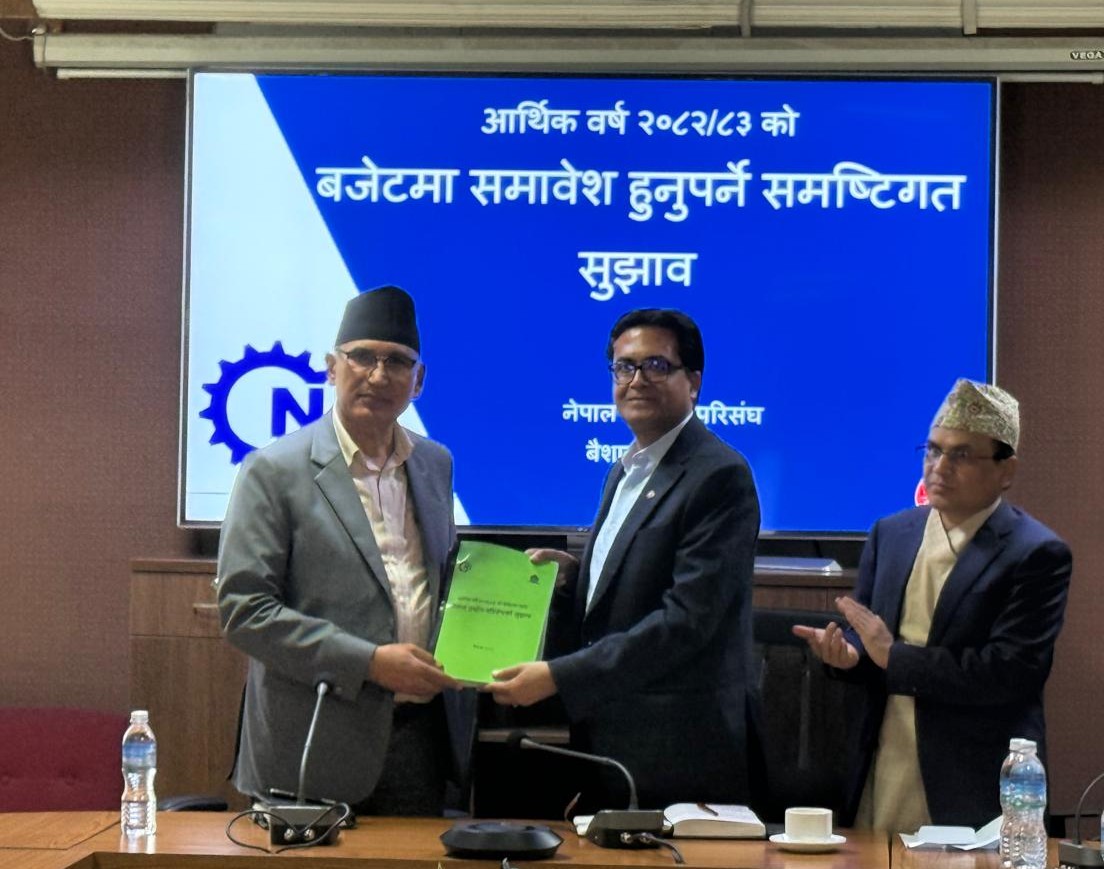


Kathmandu. The Confederation of Nepalese Industries (CNI) has submitted its recommendations to Deputy Prime Minister and Finance Minister Bishnu Prasad Poudel for the budget for the fiscal year 2082/83 BS. Taking the private sector as the engine of development, the Confederation has urged to adopt a policy to increase investment with confidence and ensure that such economic policies remain stable for the next 10 years.
Presenting suggestions on behalf of the Confederation, President of the Confederation Rajesh Kumar Agrawal stressed the need to create an investment environment with the spirit of “anything for prosperity” (Anything for Prosperity{{TAG_CLOSE_strong_24}’. He urged the government to adopt a policy to promote investment by declaring investment year for the next ten years. He stressed the need for further emphasis on collaboration between the government and the private sector for the development and promotion of domestic industries.


He said import should be discouraged to encourage such industries by identifying the goods that can increase investment in the country, increase production and move towards self-reliance by providing general regulation of imports and general concessions in domestic production. The Confederation has also provided a list of items that have become self-reliant and can be to the Ministry of Finance.
The Confederation has suggested that the customs duty on raw materials used to produce finished goods should be at least one level less than the customs rate levied on finished goods (Sub-section (d) of Section 25 of the Industrial Business Act, 2076). In the coming year, the Confederation has suggested to integrate the existing taxes (colorful) in Nepal and make arrangements for only limited types of taxes (income tax, customs, excise duty and value added tax), make the value added tax multi-rate (0, 5, 13 and 18) and reduce the minimum transaction limit to be included in this tax and everyone should be included in this tax. The Confederation believes that this will reduce the price of Nepali products, be competitive with the prices of Indian goods and markets and also help in controlling unauthorized imports. Similarly, the Confederation has also urged to integrate the system of tax collection and develop a system of collecting all taxes from one place and distributing or distributing them to different levels or bodies by the state.
The Confederation has suggested that the customs department should control the irregularities from the customs point as the theft is causing a lot of damage to the domestic industries and the government is also losing revenue from it, as well as to make intergovernmental coordination effective with clear work orders and responsibilities to control unauthorized imports and customs revenue deviationfrom outside the customs point, abolish the practice of customs reference book of customs and maintain the provision of putting the level to be imposed on imported goods before the customs point. ।
Similarly, the Confederation has suggested that at least 100 quality standards of major goods imported within the next fiscal year should be made mandatory for import by maintaining the provision of importing only quality goods in Nepal from the next year.
As the Guidelines on The Use of Indigenous Goods in Public Bodies, 2081 have been issued in the current fiscal year and the guidelines include creating a web portal for identification of indigenous goods, purchasing goods from the same portal, etc., it is necessary to ensure the effective implementation of these arrangements and immediately amend the laws related to public procurement to increase the consumption of indigenous goods in public bodies. ।
It is imperative to review the existing stringent policy rules to ensure sustainable use of natural resources. The Confederation has urged the government to simplify the existing stringent laws for the use of forest area for industries, use of timber and non-timber items, sustainable use of herbs, stones, ballast, water, limestone, mines and mineral resources. The Confederation thanked the reforms made in the laws and requested to give top priority to the reform of more laws. The Confederation has requested to make legal provisions regarding anticipatory bail, borrowing and removal of duplicity of Section 57 and 95A of income tax.
In order to attract a large amount of investment (foreign or domestic) that the country needs, it has been suggested to gradually reduce the rate of income tax on the profit of manufacturing industries to 10 percent, to restore the facility of tax exemption given to export-oriented industries on export income, to establish and operate a national startup incubation center in collaboration with the private sector.
The Confederation has urged the private sector to encourage the private sector to build large infrastructure projects such as airports and highways using investment models such as HAM, VGF, MRG, VCM, which have come into vogue and new public-private partnership. The upcoming budget has suggested policies for new industries and industrial sectors, digital economy and information technology, financial innovation, energy, tourism, urban and industrial infrastructure, roads, air, rail, water network, agriculture and herbs, education and health, and proper and sustainable use of natural resources.
The Confederation believes that addressing and implementing the suggestions presented for the budget for the fiscal year 2082/83 will significantly improve the economy and investment and contribute significantly to the country’s journey towards prosperity.
Deputy Prime Minister and Finance Minister Poudel said the government wants to create an environment to boost the morale, investment and productivity of the private sector. Stating that the government has reformed the laws in the first installment, he said that the reforms would continue until the private sector invests enthusiastically. He questioned why the investment has not taken place even when the investible amount is high and the interest rate comes at a single point. He said the government was committed to adopt whatever policy it should adopt to increase investment.
On the occasion, former President of the Confederation Hari Bhakta Sharma urged the government to bring a blueprint for policy reforms through the budget. Similarly, outgoing chairman Bishnu Kumar Agrawal suggested that the industrial sector should be allowed to operate in public-private partnership.