





Kathmandu. Captain Mohammed Ali Khoitar, 38, of Saudi Airlines Flight 163, could not be said for sure whether he was humming in the cockpit under any illusion or praying in Arabic out of nervousness. However, it was certain that apart from him, the other two people present in the cockpit of the plane, first officer Sami Hasnain and American flight engineer Bradley Curtis, knew that the situation was out of their hands.
This was on Tuesday, August 19, 1980. In the afternoon, this very modern American Lockheed Tri-Star aircraft of that time took off. At first everything was fine. But, no one knew that this trip would turn into the worst accident in the aviation industry. In which 301 passengers will lose their lives.


The plane took off from Karachi airport and its destination was the Saudi city of Jeddah. Before reaching Jeddah, the plane had to stop for some time in Riyadh, the capital of Saudi Arabia.
A total of 82 passengers and 14 crew members were on board the flight from Karachi. With 205 passengers on board from Riyadh, the total number of passengers on board the plane was 301. The passengers on board included 82 Saudis, 80 Pakistanis, 32 Iranians, 23 Yemenis and one American, Canadian and British passenger.
Saudi Airlines was considered one of the best airlines in the world at that time. The oil-rich Saudi Sultanate invested a lot of resources in its national airline. Everything was normal on the plane during the nearly 2 hours and 34 minutes flight from Karachi to Riyadh. However, about seven minutes after taking off from Riyadh’s King Khalid International Airport for Jeddah, a smoke warning system in compartment C3 on the rear cargo section of the plane sounded a danger alarm.
Smoke on aircraft during flight
American aviation safety expert Edward Douglas Dreyfus was associated with Saudi Airlines at the time. On January 16, 1982, he submitted his investigation report on the accident to Sheikh Nasser al-Fail, the head of the Civil Aviation Organization of Saudi Arabia. Many things were revealed in it.
According to the report, the reason for the fire could not be proved definitively. However, it was certainly said that two butane gas stoves were found from the wreckage of the plane. People who go for Umrah may have secretly carried it with them for cooking.
Carrying stoves on flights was legally prohibited. However, either the security checks were not done properly or they were hidden in the goods so that they could not be scanned or could not be detected by the customs.
According to the report, two gallons of cooking oil were among the other prohibited items on the plane. Dreyfus’ report says many parts of the ship are equipped with fire and smoke detection and fire fighting systems.
The cargo compartments were divided into four types: class A, B, C and D. Class D coaches were designed in such a way that if there was a fire, it would be extinguished on its own due to low oxygen content. This class also had a fire-safety barrier (liner). But, one major flaw in this design was that the compartment was too large and the oxygen level was high. For this reason the liner also quickly burned and the fire spread beyond the cargo compartment.
Earlier in the aviation industry it was believed that liners are completely safe from fire. But, this accident proved that this is not the case. When the fire broke out, it immediately swallowed up part of the plane where passengers were present. The passengers fainted before the smoke spread and then died of asphyxiation.
The last display of people present in the cockpit was not good
The Dreyfus report proved that the ship’s captain Mohammad Ali Khoytar’s training history was not very good. He was known to be a slow-learning pilot and it took him longer than other pilots to get a grip on the new aircraft.
Sami Hasnain, a 26-year-old first officer, was able to obtain a TRAI Star aircraft license just 11 days before the crash. His previous training record was also not satisfactory and he was initially dropped from the training program.
Unfortunately, flight engineer Bradley Curtis, the third member of the team in the cockpit, also did not have a very good record. Curtis, a 42-year-old engineer, was the senior-most of the three. However, he also failed several tests related to the training of TRAI Star aircraft. It was also revealed about him that he was diagnosed with dyslexia a few days ago. As a result, he had difficulty reading and understanding the machines. He was fired for not completing the training on time. However, he trained to become a flight engineer at his own expense and returned to his job.
The three had only 670 hours of flying experience on l-1011. According to training records, all of them were considered weak pilots.
According to the report, there was a huge lack of coordination and discussion among the three. For example, a Saudi captain once called an American engineer a “donkey.” Which shows the lack of trust between them.
According to experts, this employee belonged to a different culture and language. In such a delicate situation that cannot be called the ideal team.
What happened to the plane when the fire broke out?
According to the report, first one smoke detector and then another smoke detector also started indicating smoke. Initially, the captain continued to fly thinking it was a false alarm. In such a situation, the flight engineer got up from his seat and went to the cargo cabin and saw a lot of smoke and told the captain that there was a fire. Upon hearing this, the captain decided to take the flight to Jeddah back to Riyadh Airport.
According to the report, the captain had to turn the plane towards the nearest airport as soon as the smoke alarm went off, but that decision was dangerously delayed and it took about five minutes to decide to take the plane back to Riyadh. During this time, the captain, first officer and engineer kept talking to each other about unnecessary things. After this, the captain’s humming in Arabic at such a crucial time can be a sign of emotional closure for experts.
What was Captain Khoyter doing in the cockpit?
Renowned aviation writer Admiral Claudeberg wrote his research report on the ‘Medium’ website. He says that the ‘resource management of the crew’ by the cockpit employees in this accident is very weak. ’
All three had only 670 hours of flying experience on l-1011. According to training records, they were considered weak pilots.
Flight engineer Bradley Curtis repeatedly gave the right advice to get out of the plane. Which captain Mohammad Ali Khoytar ignored. First official Sami Hasnain also did not make an impact and he often spoke only when asked directly by the captain. Curtis was the most aware of the gravity of the situation among the three. However, Captain Khoyter called him an ‘ass’ meaning he was not paying any attention to Curtis’s suggestion.
Claudeberg mentions another theory, which appears to be serious but less reliable. According to this, an American defense contractor named Michael Busby claimed in an article in 2010 that the reason for not evacuating Flight 163 immediately was the Saudi king’s Boeing 747 aircraft. Which was ready to fly at that time. Basbi was living near Riyadh airport at the time and witnessed the crash.
According to Basby, the protocol was that all flights had to be stopped when the king’s plane departed. It is possible that flight 163 employees feared that if they disembarked the 300 passengers on the runway immediately, they would create obstacles to The King’s flight and face severe punishment.
Took 29 minutes to open the door
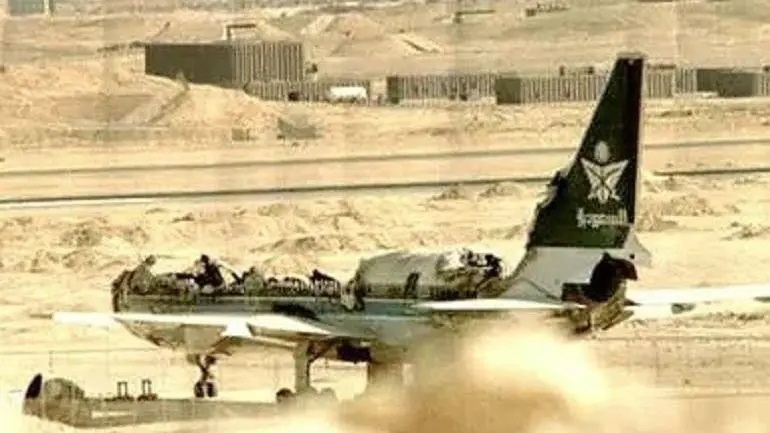
According to the report, the plane landed successfully at 6.36 pm but the captain did not impose an emergency brake (maximum braking force). As a result, the plane was able to run on the taxiway for more than two minutes. However, the hydro-mechanical pressure was working effectively. If emergency brakes had been applied, the plane would have stopped at the runway about two minutes in advance, making it possible for nearby emergency personnel to get to the plane immediately.
The next task was to open the door. For which the engines had to be closed, but it also took six minutes. When the firefighters and rescue teams finally reached the door of the plane, the doors were jammed. Most of the rescue team personnel neither had the necessary training to open the doors of the Tri-Star aircraft nor did they have the necessary machines to open its mechanism.
Rescue workers could not open the door of the aircraft in time as the captain did not immediately turn off the engines. The handle of the R-2 door was not pulled from inside. The sudden fire and toxic fumes may have left the cabin staff helpless. This delay wasted precious time and the survival hopes of passengers and employees disappeared.
During this time, not only did carbon monoxide spread completely inside the cabin, but the temperature of the cabin also increased abnormally due to the fierce fire. When the door was opened, everything was over. Most of the passengers’ bodies were found burnt or completely burnt in the front of the cabin. Where they had gathered to escape toxic fumes.
Firefighters had just entered the plane. In a few moments, suddenly there was a fire again. As a result, a portion of the plane’s roof hung and firefighters were forced to retreat.
What was wrong with the Lockheed plane?
When Lockheed L-1011 Tri Star first flew in 1972. It was regarded as the safest and most modern passenger aircraft of its time. The big three-engine jet was popular for its state-of-the-art technology and features. These included automatic flight control system, advanced navigation system and comfortable cabin design. Many of its features were later adopted by other airlines. Saudi Airlines added Jet to its fleet. Mainly for long-distance flights and it was also used in some domestic flights. However, the crash of Flight 163 raised questions about whether the aircraft’s design was fundamentally flawed.
According to Douglas Dreyfus’ report, the real problem was not the aircraft’s technology. However, the design of its fire safety system and the personnel were at fault. The cargo compartment was designed as class D. Where the fire was expected to be extinguished on its own due to limited oxygen. But that didn’t happen. It turned out to be wrong. Because the fire spread and the fireproof liner failed.
The official investigation into the accident did not include the statements of the families of the deceased. However, a fire truck driver was an eyewitness. He said thick white smoke was emanating from the rear of the ship and the rescue team repeatedly failed to open the door as the engine did not stop. “It was difficult to enter for about 25 minutes after the plane stopped and when the door was finally opened, the cabin was completely filled with toxic smoke and there was no sign of anyone alive inside,” said Retired Air Commodore Jamal Hussain of the Pakistan Air Force. Both technical and human errors appear to be involved in the accident. ’
The exact cause of the fire could not be ascertained in the investigation. The stove recovered from the wreckage of the plane could not be clearly proved guilty. The research report said that the pilots could have adopted better methods of ’emergency evacuation’. However, it is not known why the captain did not do so.
The Douglas Dreyfus Investigation Report clarified that life could have been saved in this accident if the decision had been taken immediately and proper training had been given.
The accident was technically ‘liveable’. But human and systemic flaws made it disastrous. Staff decision-making delays, negligence in emergency evacuations, poor training and lack of fire safety systems on board killed all 301 passengers. However, despite the emergency, the aircraft landed successfully.
This accident in Saudi Arabia forced a new thinking on the rules and protocols related to flight safety at the international level. This was followed by better fire detection and fire fighting systems, emergency training of personnel, quick evacuation methods, and better coordination between air and ground personnel.
Flight 163 crash is still taught as a case study in aviation academies around the world, and it has been said that air travel can be made safer not only by technical expertise but also by taking the right decisions at the right time, adopting immediate safety measures and coordinating well. -Translated from the BBC