



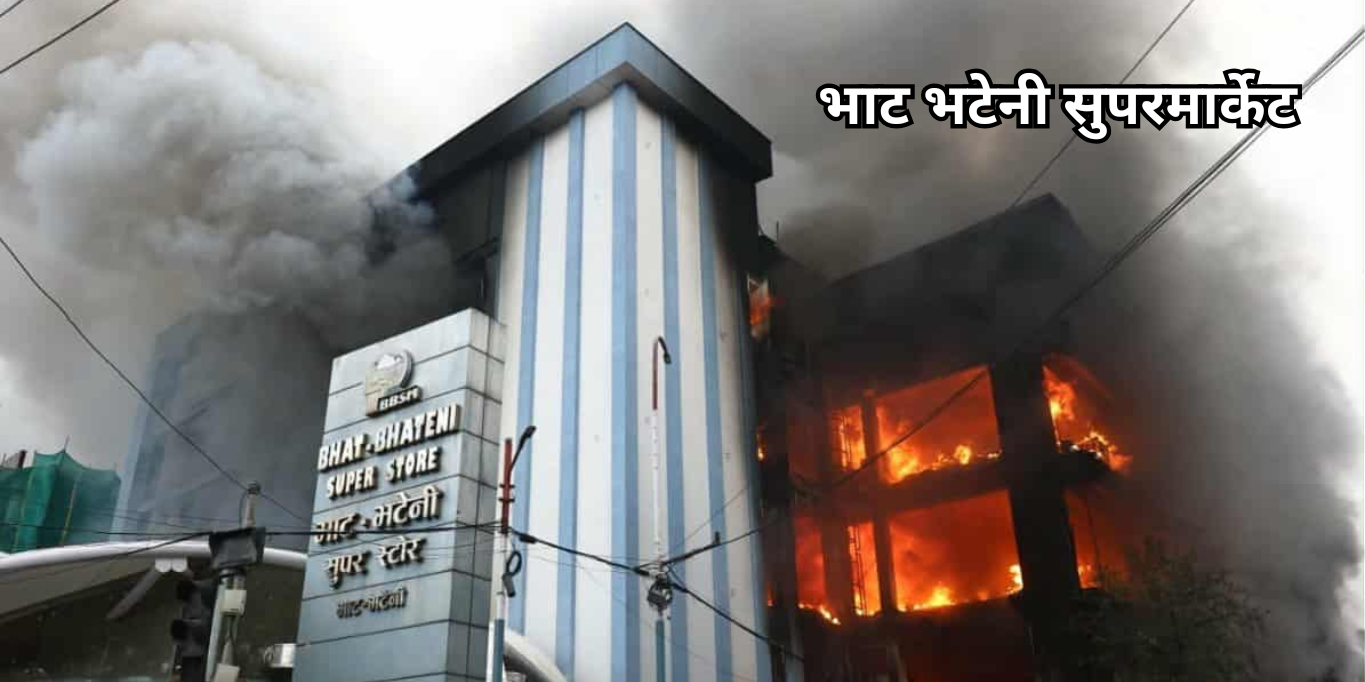

Kathmandu. In the third week of August, 20 people, including protesters, were killed in fire that broke out in Bhatbhateni supermarket and other commercial buildings in various cities of the country. Those who climbed up to the building to see Ramita, could not find an escape route, and were on the upper floor of the building for theft and robbery.
They found no way to save themselves from the fire set by the vandals in the riots. They were locked inside, suffocated, and burned to death. Most of the buildings in Bhatbhateni are built in such a way that you don’t know what is happening to the outside world once you enter them. Often, these commercial buildings are built with staircases, elevators, and elevators within the building’s main structure to lure customers into the shopping environment. But at the same time, there is enough open space and an outer ladder to escape in case of an emergency. Apart from this, there are security signs on the ground and a line showing the way even in the dark.



Since it was a deliberate arson in Bhatbhateni, there were not many people who were concerned about the sensitivity towards the deceased. However, if a fire breaks out on one floor of the building by accident, there is no way to escape except the staircase in front of the building. In most of the buildings of Bhatbhateni, staircases leading to the entry and exit of each floor are placed on the same side i.e. in front of the building. There are no security signs on the floor of the building that glow even in the dark. There are no safety signs or practice of informing shoppers at Bhatbhateni about the way to get out of each floor if the main gate of each floor is blocked due to fire or any other reason.
Police said that the identities of those who died in the fire are yet to be ascertained.
Commercial buildings are unsafe:
Covering a multi-storey building and a multi-storey building where the general public is regularly commuted increases the risk of death due to suffocation rather than fire.
It has been observed that the public purpose buildings of big business establishments like Bhatbhateni Superstore, which are usually crowded with the general public, have been constructed ignoring the security sensitivities. The stairs leading up and down the Bhatbhateni superstore are on the same side of the building. During a fire, the elevator elevator may be turned off or automatically shut off because of the increased risk.
In the multi-storey building of Bhatbhateni Supermarket, there is no provision for an open staircase attached to the main structure in the buildings. At present, the management of Bhatbhateni Supermarket has not been directly held responsible for the death caused by the protesters. But in normal circumstances, if the whole building catches fire due to a short circuit or unexpectedly, how will the customers who went to shop, go to the cinema, eat and drink there and get out safely?
The National Building Code contains provisions relating to commercial buildings
In Nepal, the requirement of an externally connected staircase (often referred to as a fire escape or exterior staircase) is generally mandatory for medium-height and tall buildings. The building has a large floor area and high foot traffic, according to the Nepal National Building Code, specifically NBC 206, which has a provision regarding fire safety under the Building Structure Standards.
The code prescribes external evacuations for safety in case of emergencies such as fire or earthquake. Adequate exits (doors, porch, staircase, ramps) should be provided in multi-storey buildings for safe exit.
The code requires that at least one part of the stairs face outward in order to escape in an emergency. This is an important provision for ventilation and access to the rescue team.
In case of a fire, the outer stairs must be directly connected to the ground floor for rescue. The entrance to the staircase should be separate from and away from the main inner staircase.
Santosh Pandey, structural engineer at the Urban Management Department of Kathmandu Metropolitan City, said that 20 percent of the buildings that do not meet the fire safety standards are yet to be approved. “Still, 90 per cent of such buildings are not being built in terms of fire safety, which is the reality,” he said. ’
Pandey said that fire safety standards will now be mandatory in multi-storey commercial buildings and residential buildings above 5 floors in Kathmandu.
“It seems that the fire safety standards are not being followed in the previous buildings. “There is still a lot of problem in the main urban areas,” he said, “Therefore, we are discussing to implement the fire safety standards mandatory.” ’