




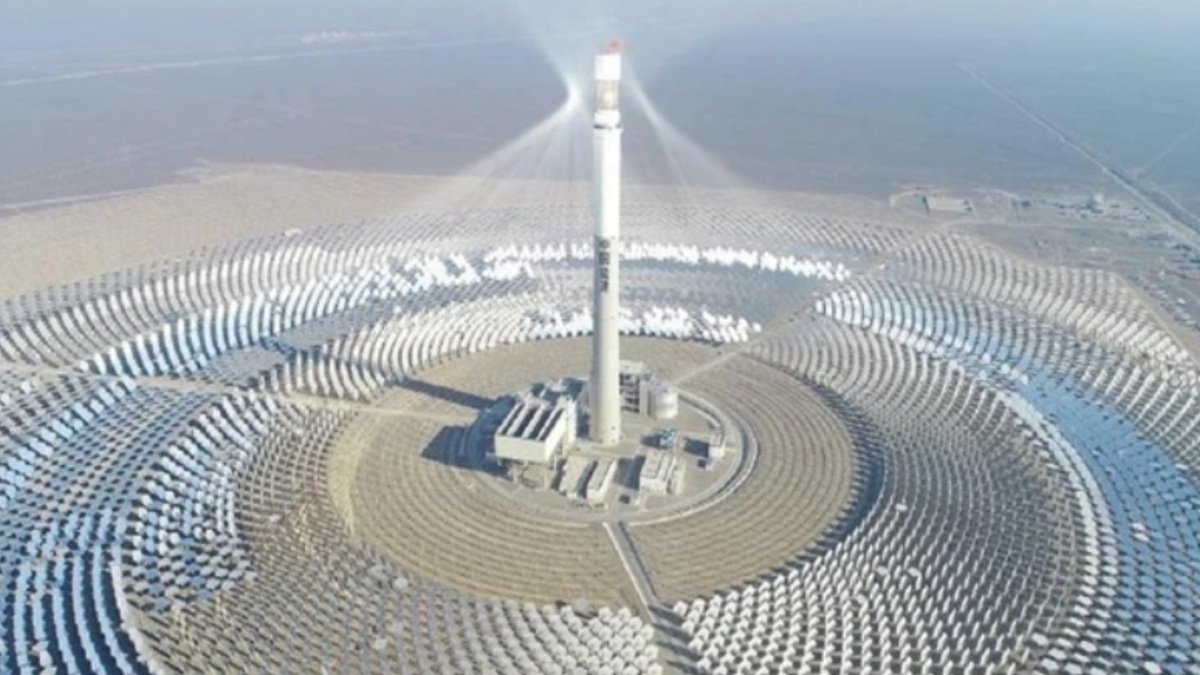

Kathmandu. China has made a historic achievement in the field of renewable energy with the operation of the world’s first twin-tower solar thermal power station. The project has been set up in the Gobi Desert in Guizhou county of China’s Gansu Province, where the previously uninhabited desert is turning green.
The centre was built by China Three Gorges Company. The 27,000 heliostat mirrors, located about a kilometre apart between the two 200-metre-high towers, focus the sun’s light. The temperature obtained from these mirrors reaches about 570 degrees Celsius. It produces steam and generates electricity by running turbines.


New Technologies and Efficiency in Energy Generation
}
This dual tower system focuses the morning sun on the east tower and the afternoon sun on the west tower. According to the scientists, the continuous flow of energy throughout the day increases the power generation capacity by about 25 percent. What’s more important is that the system can store heat, so it continues to generate power even in the evening and during cloudy weather.
At a time when the instability of solar energy is considered to be the main challenge in many countries of the world, China’s technology has shown a new way of solution.
The Miracle of Greenery in the Desert
The Gobi Desert, once filled with hot sand and dry air, is now lush green. According to a study conducted by researchers from Xian University of Technology, solar panels reduce soil temperature by 3 to 5 degrees and reduce evaporation. As a result, up to 60 percent more moisture remains in the soil and facilitates plant growth.
The study showed that the biodiversity of solar panels is significantly higher than in the exterior. In this way, solar projects have become not only a source of energy but also a catalyst for environmental regeneration.
‘Sand and Solar’ Model: China’s Long-View
China has called this concept the “sand-plus-solar” model. It involves controlling deserts, expanding greenery and producing renewable energy. Under the Great Green Wall, China aims to regenerate 670,000 hectares of land between 2025 and 2030 by installing 253 GW of solar systems in deserts. During this period, there is evidence that the rate of planting saplings has increased by 15 percent in places like the Kubuki Desert.
Local Benefits: Employment and Sustainability
These projects have not only produced energy but also brought jobs and economic revitalization. Local residents are involved in irrigation, plant care and maintenance work under the panels. It has brought environmental responsibility and livelihoods on the same path.
Another benefit is that it is estimated to reduce millions of tons of carbon emissions. In this way, China has promoted greenery, jobs and clean energy in the desert at the same time.
This model of China is an important example for a geographically diverse and hydropower-centric country like Nepal. Investment in solar energy, apart from hydropower, is also increasing in Nepal, but its sustainability and environmental impact assessment is still weak.
China’s “energy and environment” approach could be a new prospect for Nepal’s desert regions (such as Manang, Mustang, Dolpo) or the arid Mid-West region. If the government can combine long-term planning and technology, Nepal can achieve both energy self-sufficiency and environmental regeneration.
China’s solar revolution, which began in the Gobi Desert, has sent a message to the world. They are not only anti-green and anti-technology, but complementary. Solar panels produce not only electricity, but also soil moisture, plant life, and confidence in human future.