



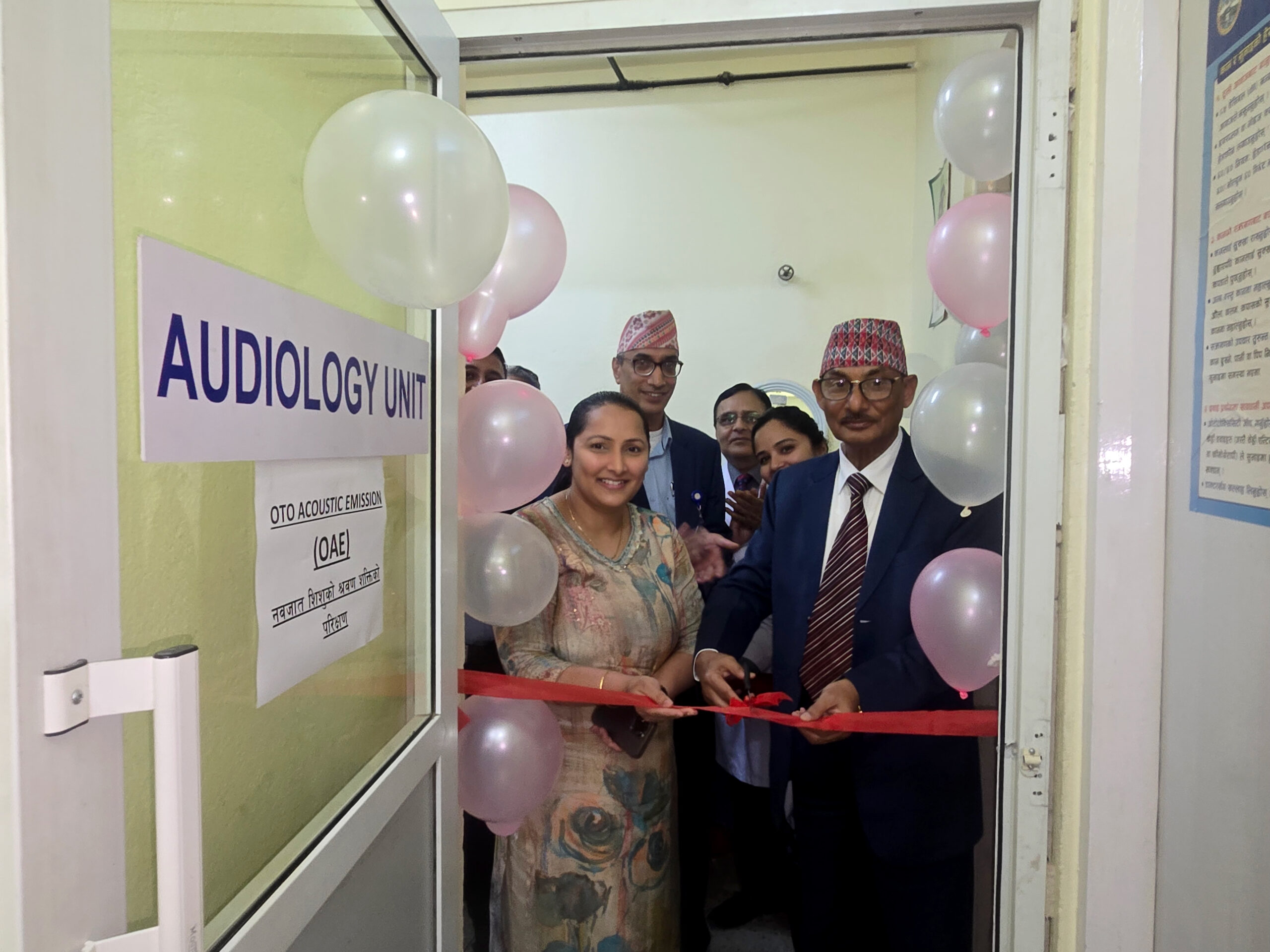

Kathmandu. Nepal Medical College has brought into operation a state-of-the-art OAE device to test the hearing of newborns. The Ochoacoustic Emission (OAE) test device has been brought into operation in the college’s ENT Department.
On Monday, college president Prof. Dr. Zainuddin Ansari inaugurated the state-of-the-art OAE device at the Audiology Unit of the Ear, Nose and Throat Department and said that the OAE device would be important for testing the hearing of newborns. Testing hearing after birth will help control congenital hearing disabilities, said Prof. Dr. Ansari.


‘The government has approved the Newborn Hearing Screening, Directive 2081, making it mandatory to test newborns for hearing problems. We have installed OAE equipment in the ENT OPD to give meaning to the government’s campaign.’ Prof. Dr. Ansari said.
The guideline states that if health workers receive any information about hearing from parents, they should check and refer them to the nearest health institution with ear, nose, throat and audiology services for further investigation. In accordance with this provision, other hospitals in Nepal Medical College can refer for hearing testing.
It has been said that the test should be conducted after informing the parents about the fertility within 12 to 24 hours of birth or when they first come for follow-up. According to the guidelines, arrangements have been made to provide testing and treatment to children who are not able to receive treatment at the initial testing site through ear, nose, and throat hospitals equipped with state-of-the-art OAE equipment.
It is estimated that 1.8 out of every 1,000 babies born in Nepal are born with hearing loss. According to the 2078 census, 3,000 children under the age of 5 had hearing-related disabilities, and studies have shown that 60 percent of deafness in children is preventable. ‘If a child’s hearing is tested as soon as he or she is born, deafness can be prevented to a large extent.